 KFOG's Irish Greg and I talk about Saturn and a Double Star, the Big Dipper and asterisms, a fun event where I'll be showing off the night sky, observatories that have public viewing nights, and a massive solar flare. Listen here. A good time is guaranteed!
Showing posts with label Big Dipper. Show all posts
Showing posts with label Big Dipper. Show all posts
Friday, June 10, 2011
KFOG Podcast - June 10, 2011
KFOG's Irish Greg and I talk about Saturn and a Double Star, the Big Dipper and asterisms, a fun event where I'll be showing off the night sky, observatories that have public viewing nights, and a massive solar flare. Listen here. A good time is guaranteed!

Saturday, February 12, 2011
The Winter Sky Beckons
 The Winter Sky beckons me to stop what I am doing and pay attention, for the view of the heavens in this magical season is unlike any other. Here in San Francisco, when it is not raining (as was the case for most of January through today), the air is dry and the atmosphere clear, giving the casual observer sparkling vistas into the heavens. And as this kind of weather happens with regularity in the winter, and the hours of darkness are at their maximum, it is all but impossible to miss the winter sky.
Evenings right now are dominated by the slowly fading planet Jupiter high in the west at sunset, and the colorful bright stars of Orion high in the southern sky, Canis Major and Sirius to the lower left of Orion, and Taurus and Aldeberan to the upper right of Orion. Facing north, the Big Dipper and Cassiopeia trade places every 24 hours, circling Polaris, the North Star. And later in the night to the east are a variety of treasures in Virgo with Saturn in the vicinity. Two weeks ago the morning sky featured the old Moon passing through Scorpios and Sagittarius, creating beautiful alignments that accented the eastern horizon at dawn.
The most important thing to do, if you want to see these amazing sky spectacles, is to keep your eyes open and look up - - nothing more than that is necessary to be captivated by the spell of the sky. No need for a telescope or binoculars. This time of year the stars dazzle in the night, and appear to be asking all of us to take a moment to contemplate their majesty and come to appreciate the universe, awaiting your view each night of the year.
Saturday, May 29, 2010
High in the sky: The Big Dipper
 The Big Dipper is one of the easiest groupings of stars in the sky to identify, and it serves as a guide to some of the more interesting stars in other parts of the sky. Late Spring evenings it is nearly overhead as seen from San Francisco, and its distinctive pattern provides an interesting exercise for understanding the motions of objects in the heavens.
The Big Dipper is not a constellation, by strict definition, because it is only the brightest 7 stars of the larger constellation Ursa Major. A named combination of stars within a constellation such as the Big Dipper is known as an "asterism." Because of its distinctive shape, the Big Dipper is a very well known asterism, one of several celestial groupings that lives up to its name (I put Leo, Scorpius, Cygnus and a few other constellations in this special class).
The Big Dipper points to the North Star (Polaris) if you follow the two stars at the side of the bowl of the dipper. This Wikipedia article illustrates this nicely. The line along the pointers from the Big Dipper to Polaris is helpful because this line is similar to an hour hand on a 24-hour clock. Every 24 hours the Big Dipper makes one counter-clockwise rotation around Polaris. From latitude 38 degrees north (approximately the latitude here in San Francisco) the Big Dipper is high in the sky when it is above Polaris (as it is now at sunset) and low in the sky when it is rotated half way around Polaris just above the horizon (as it will be in late Fall evenings).

The three stars in the handle of the Big Dipper form a curve, and if you think of this curve as an arc, you can follow it to a very bright star called Arcturus (in the constellation Bootes), and by continuing along this arc you end up at another bright star called Spica (in the constellation Virgo).
One more fun thing to find in the Big Dipper is the middle star of the handle, known as Mizar (see image above). This star has a very close companion, Alcor, next to it and if you want to test your eyesight, see if you can split the two without using binoculars or a telescope.
Enjoy learning about the Big Dipper in the pleasant weather of May and June. It's full of surprises and one of my favorite stops when sharing the sky with friends and guests at star parties.
Wednesday, December 9, 2009
The Northern Sky: Circumpolar Stars and Polaris
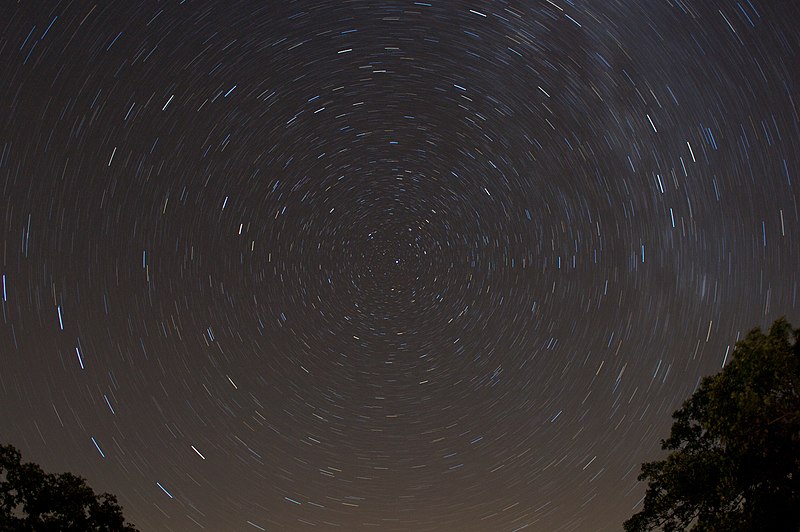 I enjoy stargazing for many reasons, one of which is to get a sense of the motion of the sky as viewed from our vantage point here on Earth. As I have traveled around the globe, I've always tried to observe how the sky changes depending on where you view it from. One of the more fundamental things you can observe is the dynamic of the stars and constellations in the northern sky. For those of us who dwell in North America, we see the north star, Polaris, at the same height in the sky as we are located north of the equator. That is, for San Francisco at approximately 38 degrees north latitude, Polaris can be found due north, 38 degrees above the horizon.
For reasons you can read about in Wikipedia, Polaris does not move in the sky and therefore is never below the horizon. It is always fixed in the north above the horizon at the same arc as you are located north of the
 equator. However, the stars that surround Polaris also never dip below the horizon, but rather circle around Polaris in a 24-hour spiral that turns counter-clockwise. Long-exposure photographs show this effect very vividly.
Wonderful constellations and asterisms occupy the circumpolar region of the sky, including the Big and Little Dipper, Cassiopeia, Draco and Cepheus.
Subscribe to:
Posts (Atom)


