Showing posts with label Moon. Show all posts

Tuesday, December 13, 2011

Geminid Meteor Shower 2011

The Geminids peak the nights of December 13th and 14th this year, one of the better meteor showers of the year. Unfortunately for 2011, most of the Geminids will be nearly invisible due to the very bright Moon that dominates the late night and early morning sky, when the Geminids are at their best.

The effect of a bright Moon on a meteor shower was vividly illustrated to me during the Total Lunar Eclipse a few days ago. I was at Ocean Beach on the west coast of San Francisco for the eclipse in the early morning hours. Facing west, Gemini was directly in front of us, dominating the western sky. As the brightness of the Moon faded, we began to notice meteors -- we were seeing some very early Geminid meteors, facing the radiant directly. I was very surprised at the stark contrast in meteor visibility from Full Moon before the eclipse started, to an ever-increasing amount of meteors over a very short period of time as the Moon, in effect, when through all of its phases in about 60 minutes. It reaffirms for me the huge difference a moonlit night makes when watching a meteor shower.

Although the meteors will be diminished for the Geminid Meteor Shower in 2011, I'll still take a look, since a big shower like this has plenty of bright meteors that pierce the night despite moonlight. If you want to read more about the Geminids, check out this interesting article about the Geminids radiant, from Earth Sky, from the LA Times, or this one from NASA Science News.

Image courtesy EarthSky.

Tuesday, December 6, 2011

Total Lunar Eclipse 2011 - in San Francisco

Saturday morning, we will witness a Total Lunar Eclipse visible from western North America and regions across the Pacific Ocean. In San Francisco, we will have a dramatic early morning spectacle of the fully eclipsed Moon setting on the Pacific just as dawn breaks. As with any total lunar eclipse, the Moon's surface will be completely covered by the dark 'umbral' shadow of the Earth, but it will remain visible, taking on an eerie appearance of rusty red, or deep grey, or a mix of colors. Every eclipse is a little bit different, so we wait in anticipation to see what happens Saturday morning.

The circumstances of this eclipse are outlined in detail in this informative Sky & Telescope article, and this excellent NASA Science News article.

The timeline for San Francisco (and the entire pacific time zone) are: start of eclipse at 4:45 am, start of totality at 6:05 am, and end of totality at 6:57 am. The glow of the dawn sky will emerge in the eastern sky shortly after 6:00 am, so the Moon will be in total eclipse as the sky begins to brighten, and by the time the Moon exits the total phase, the sky will be fully lit in advance of the sunrise at 7:13 am.

What does all this mean to the casual viewer? You will experience the best views and the most drama from 4:45 am until 6:30 am, when the Moon gradually changes from full to completely eclipsed, and the skies are dark enough to appreciate the beauty and subtlety of the lighting and color of the lunar surface. And as the Moon's brightness is attenuated as the Earth's shadow creeps across the surface, the backdrop of stars will begin to shine more brightly by contrast, revealing the wonderful winter sky at its best, with the constellations Taurus, Orion and Auriga around the Moon, and some of the most beautiful, bright stars in the entire night sky punctuating the skyscape.

I welcome the public to stop by Ocean Beach on the west coast of San Francisco for an early-morning star party, where I and others from the San Francisco Amateur Astronomers (SFAA) will have telescopes set up for public viewing. We will set up at the beachwalk just across from the Beach Chalet restaurant on Great Highway, starting around 4:30 am. But heed the advice of Deborah Byrd in this EarthSky article, and wear very warm clothes. You'll be glad you did, as the winter chill is quite intense just before sunrise.

Sunday, November 20, 2011

Saturn Returns

Saturn has returned to the morning sky, rising higher each day shining in the east before sunrise. It is near the bright blue giant star Spica, in the constellation Virgo, and this week is graced by a visit from the Moon, creating a beautiful grouping on the morning of November 22nd.

Saturn and Spica are an interesting pair to compare. They are a contrast in color, with Spica shining a deep blue, and Saturn with a yellow-white tinge. Spica is 260 light years away, distant compared to many other bright stars in the evening sky, but being a giant star, it emits enough light to be the 15th brightest star in our night sky. Saturn is 80 light minutes away, a giant planet by Solar System standards, but due to its distance it never shines as bright as other Solar System objects such as Venus and Jupiter. But Saturn still captivates all who see it through a telescope because of its impressive ring system, making it a welcome target for any star gazer.

Image courtesy Sky & Telescope Magazine

Wednesday, October 12, 2011

Brilliant Moon and Jupiter

The Full Moon dominates the night sky this week, lighting the Autumn landscape and making its presence known as the soft grey glow of moonlight washes out all but the brightest stars in the sky. But even as the stars take a back seat in the night sky, the giant planet Jupiter shines steadily next to the Moon, undiminished by the intense glow of our nearest celestial neighbor.

Jupiter is nearing "opposition" in which it is at its closest approach to Earth for 2011. That means that it is also at its brightest, outshining all other celestial bodies in the night sky right now, except the Moon. For the next few nights as the Hunter's Moon passes near Jupiter, your attention will be drawn to the dazzling brightness of the largest planet in the Solar System. And once the Moon has moved into Last Quarter phase next week, Jupiter will remain steadfast in the evening sky, waiting for you to find it in binoculars or a small telescope. Take a moment and look up close if you have not seen Jupiter up-close. It's a worthy (and easy) target.

Image courtesy of Sky & Telescope Magazine.

Tuesday, September 27, 2011

Observing Twilight into Dusk

The minutes after sunset are some of the most beautiful, as the last rays of sunlight have disappeared and the sky begins its daily transition from bright blue to dark night. Looking west after sunset in the early days of Fall, you quickly find Arcturus shining due west, at first looking almost like an airplane that is moving very slowly. But soon you realize that this is a star, the third-brightest in the heavens. It is bright enough to shine clearly through the glow of twilight. The colors of the sky are changing rapidly during twilight, and the brightest stars soon emerge. In late September, you can easily find the fifth-brightest star in the heavens, Vega, directly overhead, guiding you to its neighbors Deneb and Altair in the Summer Triangle. And looking back toward the western horizon where Arcturus is shining, you can soon find the red supergiant star Antares shining low to the left (south-west) of Arcturus.

Later this week, the young Moon arrives in the twilight sky and passes near Antares. Find a nice western horizon, get comfortable, and enjoy the evening show that is pleasant, relaxing and beautiful to see.

Image courtesy of Sky & Telescope Magazine.

Tuesday, July 5, 2011

Moon in Descent

The Moon traces out a path across the sky that is slightly offset from the path of the planets and Sun (the well-known "ecliptic" path). The orbit of the Moon is inclined to the ecliptic by 6 degrees, meaning that at any given point in a month, the Moon might be found in the sky just at the ecliptic, or moving below the ecliptic (up to 6 degrees away from it), or above the ecliptic. As it travels in its 29 day journey around the Earth, the Moon passes through the ecliptic twice, once going down (descending node) and once going up (ascending node).

Since we just finished an Eclipse Season, the Moon's nodes are very near to the points in space where we have New Moon and Full Moon, enough that from the New Moon a few days ago, to the First Quarter Moon later this week, we see the Moon traveling past the descending node and moving well below the ecliptic. Visual proof of that this week comes in the form of Saturn and Spica (see image), both of which are nearly on the ecliptic. The daily change in location of the Moon shows us just where the Moon is in relation to the ecliptic, this week skirting just south (below) this imaginary line in space.

Sunday, June 26, 2011

The Moon amid planets and star clusters

The morning sky this week will be rich with easy-to-spot celestial objects in the hour before sunrise. Find a good view toward the eastern horizon and use binoculars to enhance the view of Venus, Mars, the waning crescent Moon and two of the finest star clusters in the sky, the Pleiades and Hyades. I am looking forward to it!

Sunday, June 12, 2011

The Very Long-lasting Total Lunar Eclipse of 2011

On Wednesday June 15th, viewers in the eastern hemisphere will be treated to a very long-lasting Total Lunar Eclipse, a 100-minute marathon of an eclipse that will reveal the center of the Milky Way in the backdrop as the bright Moon is enveloped in the darkest part of Earth's shadow. Unfortunately for those of us on the other side of the Earth, including here in San Francisco, we will miss the entire eclipse. (But we will get a nice lunar eclipse later this year, on December 10th.)

As for June 15th, this particular Total Lunar Eclipse will be longer than most for two reasons, (a) the Moon passes nearly through the center of the Earth's shadow, and (b) the Moon is nearly at Apogee, when it is farthest from the Earth (and hence appears a bit smaller than usual and takes longer to pass through the Earth's shadow). For my colleagues in Germany, the Moon will rise already in mid-Eclipse, which is an outstanding sight that I have seen one time in the past. Moonrise will be at approximately 9:30 pm, and the Moon remains in total eclipse until approximately 11:00 pm. That would be something to enjoy from a spot with a good eastern horizon. For other locations around the world, use this chart from the NASA Eclipse Web Site to determine the timing for your location. I wish my friends on the other side of the world clear skies and happy viewing!

Friday, June 3, 2011

Twin Stars and Moon in the West

As the days lengthen and the sky stays lit well into the evening, many familiar constellations are rapidly slipping out of view. The bright twin stars of Gemini, Castor and Pollux, are fading fast and will soon be gone from the night sky. Enjoy a few days of this sight, with the addition of a fine young Moon in the sunset sky this weekend.

Monday, April 4, 2011

The Moon and two Star Clusters: Pleiades and Hyades

The Moon graces the last vestiges of the winter sky this week, as the waxing Moon splits two of the prettiest star clusters, the Pleiades and the Hyades. This will be an exciting sight for stargazers, one that will look particularly magical through binoculars. So mark your calendar for Thursday April 7th and watch the show unfold all week long.

When the Moon emerges from the New phase and starts its 29 1/2 day journey around the Earth, the first few days are always a treat, because the waxing crescent offers so much to see through a telescope or binoculars, and even without optical aid, the sight of the thinly-lit Moon and the glow of Earthshine always catch your eye.

On Thursday, the Moon moves past the Pleiades star cluster, one of the best known clusters in the sky because the stars in it are fairly bright and concentrated into a small space, creating a kind of glow in the sky. Around the bright star Aldeberan in Taurus is the open cluster called the Hyades. These stars are also a close grouping in the sky, but not as tightly arranged, so you don't get the same kind of glow. However, through binoculars this cluster offers much to see.

Use the graphic (above) to help you orient yourself this week. You will want an observing location with a clear western horizon, away from streetlights or other distractions, and good weather. If you get all these conditions just right, you have no excuse for missing this gem of a celestial lineup. And if you live in San Francisco, come join me at the Cal Academy for a personal tour :-)

Saturday, March 19, 2011

Vernal Equinox, Super Full Moon, and other astronomical musings

I enjoy sharing highlights of the sky with friends and have been blogging for several years now, pointing out events of astronomical interest here as The Urban Astronomer. I was surprised to see the excitement and questions about the Super Full Moon, the coincidence of nature that is leading to a full moon at perigee today. The fact that the general public is being scared into thinking something bad is about to happen is unfortunate, but the fact that people will be out tonight looking at the full moon is the good outcome that I wish for. Of course, there is absolutely nothing to be worried about. Every 29 days the Moon swings a bit closer to the Earth than other times of the month, and that pattern of perigee and apogee, full and new, repeats in a beautiful "super pattern" every 18 years, something now known (but likely not fully understood) by the many who are reading about the Super Full Moon being the biggest one in 18 years.

There are numerous patterns and cycles in the heavens. Tomorrow, March 20th, is the Vernal Equinox, the semi-annual moment when the length of the day is exactly 12 hours everyone on Earth. I like that dynamic, a twice-a-year event in which we are all given equal periods of sun above the horizon and below the horizon, regardless of your latitude, regardless of whether you are in the Northern or Southern Hemisphere. That is a moment of beauty in the grand annual rhythms of our home planet.

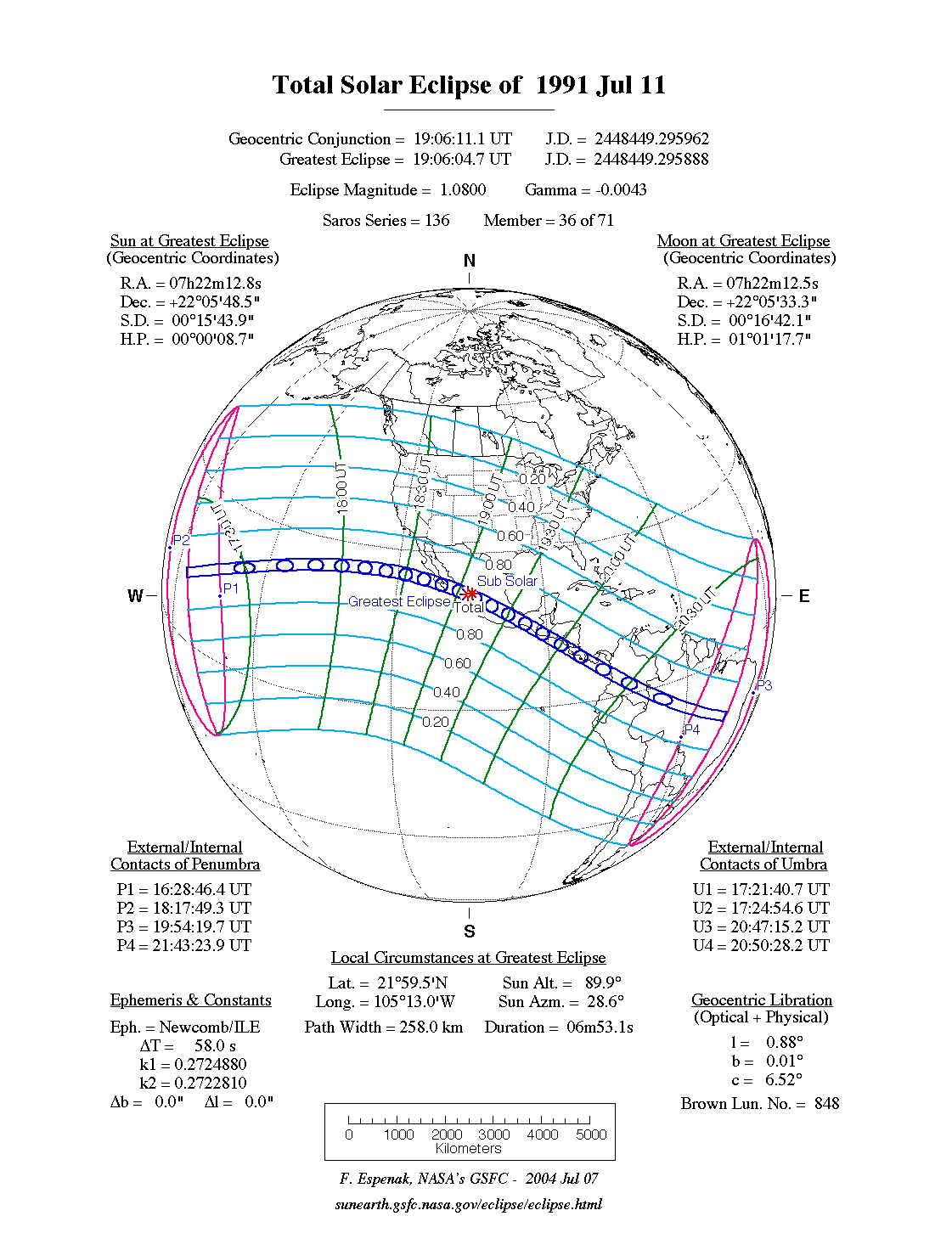
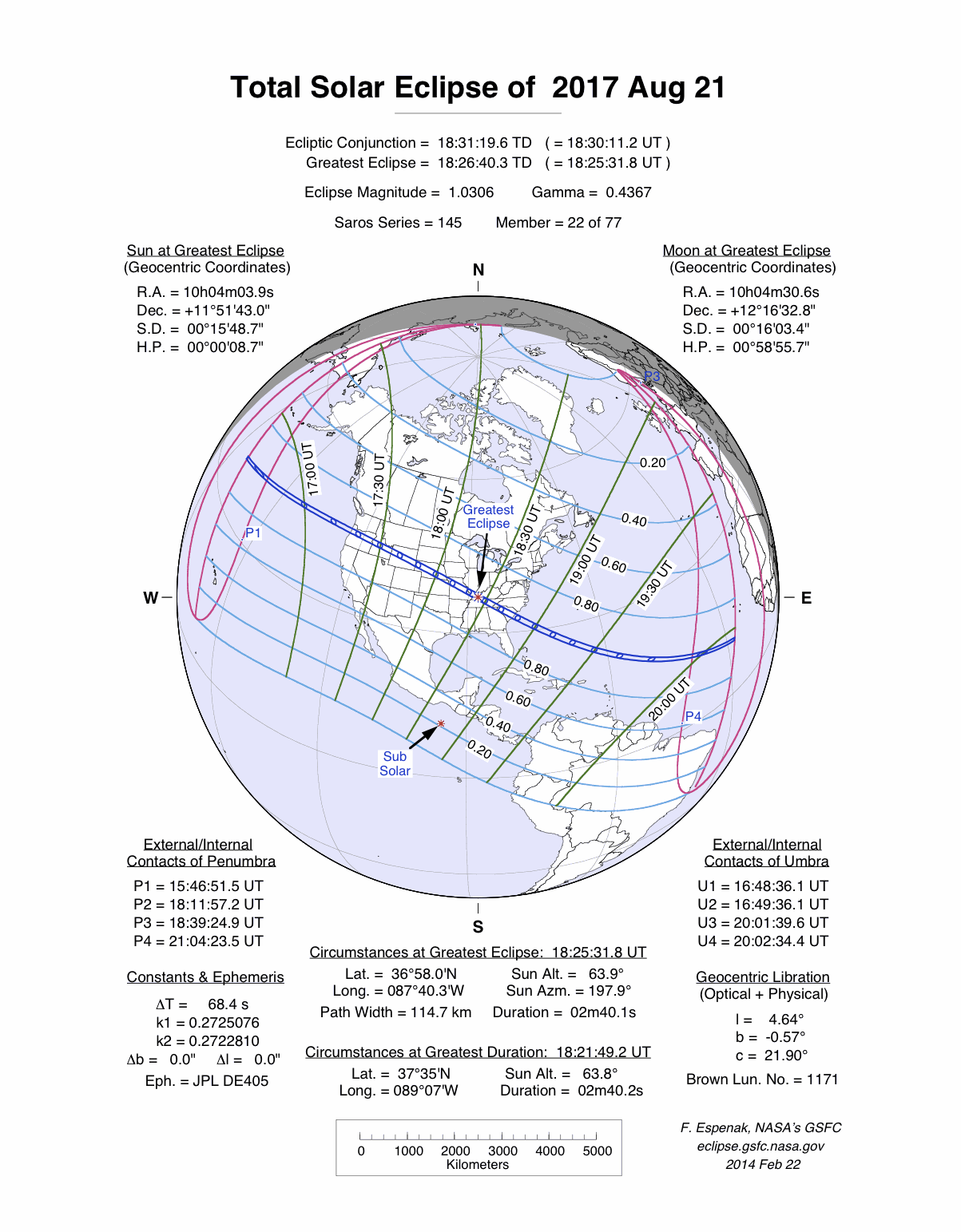
The pattern of lunar repetition that lasts for just longer than 18 years is also responsible for the cycle of lunar and solar eclipses that take place around the world. I witnessed a total solar eclipse in Europe in July 1999, and the celestial dynamics of that eclipse will exactly repeat in August 2017 when a wonderful total solar eclipse will sweep across the United States. For me, it will be a rare chance to be standing in the shadow of the Moon on the second passing of this particular alignment of Moon, Earth and Sun, one that will be far more dramatic and meaningful to me than any particular Super Full Moon you might encounter between now and then. But in the end, if you can find some meaning and solace looking up at the Moon tonight, savor the moment and mark your calendar for April 2029 when the conditions will align themselves and present you with a chance to relive this magic moment when you saw a particularly big and impressive full moon. That is something worth pondering, and the rest of the media hype you are hearing right now should be simply ignored.

Image courtesy NASA.

Saturday, February 12, 2011

The Winter Sky Beckons

The Winter Sky beckons me to stop what I am doing and pay attention, for the view of the heavens in this magical season is unlike any other. Here in San Francisco, when it is not raining (as was the case for most of January through today), the air is dry and the atmosphere clear, giving the casual observer sparkling vistas into the heavens. And as this kind of weather happens with regularity in the winter, and the hours of darkness are at their maximum, it is all but impossible to miss the winter sky.

Evenings right now are dominated by the slowly fading planet Jupiter high in the west at sunset, and the colorful bright stars of Orion high in the southern sky, Canis Major and Sirius to the lower left of Orion, and Taurus and Aldeberan to the upper right of Orion. Facing north, the Big Dipper and Cassiopeia trade places every 24 hours, circling Polaris, the North Star. And later in the night to the east are a variety of treasures in Virgo with Saturn in the vicinity. Two weeks ago the morning sky featured the old Moon passing through Scorpios and Sagittarius, creating beautiful alignments that accented the eastern horizon at dawn.

The most important thing to do, if you want to see these amazing sky spectacles, is to keep your eyes open and look up - - nothing more than that is necessary to be captivated by the spell of the sky. No need for a telescope or binoculars. This time of year the stars dazzle in the night, and appear to be asking all of us to take a moment to contemplate their majesty and come to appreciate the universe, awaiting your view each night of the year.

Thursday, January 27, 2011

Celestial Companions in the Cold Dark Morning

January mornings are dark times, and when the sky is clear it is certain to be chilly outside. So I find the sight of the old Moon reassuring, a warm light that fades a bit each successive morning and guides the way through bright stars and planets along the ecliptic to the soon-to-be-rising-Sun. You can see this spectacle at its finest the next few mornings as the Moon moves a bit further eastward each day and passes near to some distinct celestial companions.

The Moon is passing now through Scorpius and the grey-white of the Moon stands in stark contrast to the red-orange of the star at the heart of the Scorpion, Antares. Moving close to Antares on Friday morning, the Moon continues toward the brilliant planet Venus on Saturday morning, and then slowly fades into the glare of sunrise on Sunday morning. My kitchen window faces south-east so I see this changing landscape each morning and I look forward to the coming days with clear skies in the forecast. If you rise before sunrise, take a moment to look out toward the south-east and enjoy the calm of this morning celestial grouping of close companions in the heavens.

Sunday, December 26, 2010

Shimmering Early Morning Sky

As we approach the latest sunrise of the year (January 4th at 7:25 am in San Francisco), the morning sky remains dark enough to see stars until well after 6:00 am. That means that the early riser is rewarded with some lovely sights to close out 2010 and welcome 2011. Brilliant Venus dominates the sky each morning, shining bright in the South-East well before dawn. This week the waning Moon presents a changing landscape as it moves past Saturn, the bright star Spica (see diagram on the right), and then later in the week Venus and Mercury. Following the Solstice-Total-Lunar-Eclipse, the Moon is tracking downward on the Ecliptic, meaning that each Morning it is following the planets from high in the sky on a steep angle toward the horizon.

If you are not an early riser, don't despair. I'll have a post about the Winter skies soon. All you have to do is look up (especially if you are up at midnight on New Year's Eve and have clear skies). The Winter is a fantastic time to enjoy the stars.

Image courtesy of Sky and Telescope Magazine.

Sunday, November 28, 2010

Brilliant Venus and Old Moon in the Dawn Sky

With sunrise at 7:00 in the morning, I find this time of year to be one in which I can do some early morning stargazing without having to change my morning routine. This week the waning Moon provides a lovely scene against the backdrop of brilliant Venus, bright Saturn and the bright star Spica. The illustration demonstrates what to expect in the eastern skies as the Moon shrinks each day on its way to the New Moon on December 5th. If you are a morning person with an interest in astronomy, this will be an excellent week for you. Get out your binoculars for an especially riveting view of these heavenly bodies, and take in a few minutes of beauty about an hour before the sunrise.

Sunday, October 24, 2010

Waning Moon, Morning Darkness

Each month the Moon makes a 29 1/2 day journey around the Earth, bringing different faces of the Moon to light, making beautiful patterns with the surrounding stars and planets, and shining light into the evening, midnight or morning skies. Right now, the Moon is waning, getting smaller each night as it passes through gibbous phases while moving from Full Moon to Last Quarter, lining up with bright celestial objects such as the Pleiades and Taurus. During the gibbous phases, the orientation of the Moon is quite different from what we normally expect in the evening skies.

The illustration shows the changing orientation of the Moon just after sunset in the waxing phases, as the Moon grows from New to Full. This view is for Northern Hemisphere viewers. But after the Full Moon, the orientation reverses and is best measured in the sunrise sky. So the view you can see right now is of a Moon curved not toward the east as normally seen in the evening sky, but rather curved toward the west in the morning sky. It's refreshing to see this time of year while it is so dark in the morning, and it provides a chance to see things in a different light. Eye-opening.

Image courtesy of University of Virginia.

Friday, September 10, 2010

KFOG Podcast - September 10, 2010

Another fun visit with Irish Greg of the KFOG Morning Show, today featuring a discussion of constellations to see this time of year (Sagittarius, Scorpius, The Summer Triangle) and the difference between an asterism and a constellation, plus deep-space objects you can see in the Milky Way with an ordinary pair of binoculars. And the latest happenings with the Moon and Venus, and an update on a great star party and lecture this weekend. All in 7 short minutes! Click here to listen.

Monday, August 23, 2010

Perspective of the Solar System

After weeks of foggy skies in San Francisco, the sky has started clearing, yielding spectacular sunsets and sky shows at Ocean Beach. I have been writing about (but not seeing much of) the amazing sight of the planets dancing across the evening sky. With the clear skies, the view was great, showcasing Venus and Mars very close together, with Saturn just to the lower right and the bright Zodiac start Spica (in Virgo) just to the upper left.

This configuration traces a curve in the sky and if you have a clear southern horizon you can "connect the dots" from this cluster of stars and planets to the south where bright Jupiter dominates the sky. Beyond that, the Moon is slicing across the lower southern sky, providing the observer with a nice visual of the Ecliptic, the line of the planets, Moon and Sun. This is a great way to visualize the path of the planets in the Solar System when you look out from our Earth-bound perspective.

Over the coming months, Mars and Saturn and eventually Venus fade, but the giant planet Jupiter will be dominating the Fall skies.

Sunday, July 11, 2010

A Must See: Four Planets and the Moon

This week the sky features four of the brightest planets in a beautiful lineup in the sunset sky. The illustration on the left, borrowed from Sky & Telescope Magazine, demonstrates how the planets all align themselves in a path across the sky known as the Ecliptic. This line in the sky, actually a gentle curve from west to east across the south part of the sky, is the plane of the Solar System as viewed from our observing platform on Earth. We see fast-moving Mercury close to the Sun, then Venus, Mars and Saturn, a most impressive line-up.

To set this into perspective, the young Moon emerges from the glare of the Sun on Tuesday 13th, moving somewhat parallel to the Ecliptic but each day a bit farther south of the Ecliptic. This is because the orbit of the Moon around the Earth is slightly inclined to the rest of the bodies in the Solar System. And as we just had a Total Solar Eclipse on Sunday, the Moon is following a path away from the Ecliptic into what is called the "descending node" south of the Ecliptic.

I will be talking about this at the California Academy of Sciences at their Nightlife event this Thursday in Golden Gate Park. If you are in or near San Francisco, please join me on the roof for Star Tours!

Saturday, June 19, 2010

The Path That Leads to the Earth's Shadow

We are in an "Eclipse Season," a five week period of time when the Moon's orbit around the Earth is aligned in a way that the Full or New Moon crosses the path of the Earth around the Sun. When that happens, we experience a Lunar or Solar Eclipse and right now we have one of each coming up: a partial Lunar Eclipse on Saturday 26th, and a total Solar Eclipse on July 11th. The Solar Eclipse will not be visible from North America so we don't get a chance to experience that, but the Lunar Eclipse will be. More on that next week.
During an Eclipse Season, the Moon's position in the sky is special, as it is moving just above or just below the plane of the planets (the "Ecliptic") in the interval from New Moon to Full Moon. A few days ago as the Moon emerged from the evening glare waxing each evening, you could see it move just below Venus, then below Regulus and Mars, and now it is below Saturn and Spica, all objects on or near the Ecliptic. As it nears Full Moon and the Lunar Eclipse on the 26th, it is moving closer and closer to the Ecliptic and will intersect the Earth's shadow on the 26th.
I like to imagine that there is a dark spot in the sky where the Earth's shadow projects out into space. Every month as the Moon nears Full, it sweeps close to that spot. But only during an Eclipse Season -- every six or twelve months -- does it slip into the shadow of the Earth and display to all of us the curved shadow of the Earth. That is something to look forward to next weekend.