The Orionid Meteor Shower peaks for the next two mornings, October 21 and 22, as the Earth passes through a debris stream left by Halley's Comet. Like all annual meteor showers, the Orionids occur at the same time each year because the Earth, in its 365-day trip around the Sun, passes through areas of increased debris, leading to a much more focused period of time with meteors flying into Earth's atmosphere and creating those beautiful streaks of light that magically light the sky for a moment and then vanish without a trace.
The name Orionids tells us that the meteors in this shower appear to emanate from the constellation Orion, the beautiful winter sky constellation. But like the best meteors in any shower, you won't see Orion until after midnight as it rises out of the east. Meteor showers are best observed between midnight and sunrise, when you are viewing meteors entering our atmosphere on the 'front face' of the Earth. Given that sunrise is quite late this time of year, take advantage of that and get up just ahead of dawn's light, around 6:15 in the San Francisco Bay Area.
Image courtesy of Earth Sky.
Showing posts with label Meteor. Show all posts
Thursday, October 20, 2011
Wednesday, May 4, 2011
Eta Aquarid Meteor Shower 2011
The Eta Aquarid meteor shower peaks Thursday night, the night of May 5th into the morning of May 6th. This is not the biggest meteor shower of the year, but it certainly is interesting because it is caused by small bits of debris from the trail of Halley's Comet, the famous comet that orbits the Sun and is visible from Earth every 76 years. Comets leave small trails of debris in their wake, and comets that have orbits that intersect the orbit of Earth around the Sun create our annual meteor showers. So if you see an Eta Aquarid meteor tonight, you'll know it was once part of Halley's Comet, having been stripped away by the heating of the Sun on some past fly-by of Earth.
To see this shower, as is the case for all meteor showers, you need a dark location (even a backyard shielded from streetlights in the city will do), warm blankets, a recliner chair or a patch of grass to lie on, a big view of the sky, and patience. The name of this shower is based on Aquarius (the constellation) where the meteors appear to originate from, but they are visible all over the sky. Best viewing for this shower is early morning. The dawn sky will start to brighten around 5:00 am, so you will need to start early Friday morning if you want to see these. Have fun!
Thursday, December 30, 2010
Quadrantids Meteor Shower - January 3-4, 2011
As always, the best viewing of any meteor shower is from a dark location, ideally away from city lights. But I have had some success right in my backyard in San Francisco by positioning myself away from direct lights such as streetlights and houselights, and allowing myself 5 to 10 minutes to adapt to the darkness. Once dark adapted, the winter sky shimmers and Quadrantids are readily visible. In dark skies outside of cities you can expect up to 2 meteors per minute, but in the City I am happy to see 1 meteor every few minutes. This year should be as good a show as any, and despite our rainy Northern California weather the outlook is good.
To see this shower, position yourself facing northeast but give yourself as much of a view of the sky as possible. A lawn chair is best (along with blankets and a hat), as the meteors appear to originate in the constellation Bootes in the northeast part of the sky, but the meteors radiate in every direction away from this point.
For some fun background and history of this meteor shower, check out Astronomy.com and NASA's "What's Up" blog series. Image is courtesy of NASA.
Stay warm, and here's to good skies!
Wednesday, August 11, 2010
Perseid Meteor Shower 2010
The Perseids peak on the nights of Thursday 12th and Friday 13th, with best viewing on Thursday night / Friday morning. You can get detailed information on the Sky and Telescope website or on numerous other web resources.
The best way to see the meteor shower is to find a dark location, give your eyes plenty of time to adapt to the darkness, and be prepared to stay up late (or get up early). Meteor showers are almost always best viewed after midnight when the Earth is powering directly into the meteor stream and the rate increases substantially. The Perseids appear to originate in the constellation Perseus which is in the east after midnight, but that does not mean you have to specifically look east to see the meteors. Lying on a blanket facing directly overhead gives you the most expansive view and you can see meteors coming from the east or passing overhead toward the west. Meteors are wonderful, fast, elusive wonders and you simply need to be warmly dressed, in a place where you can see as much of the sky as possible without light distractions, and patience. I wish you clear skies and a great night or two observing.
Monday, August 10, 2009
Perseid Meteor Shower 2009
It's August and that means its time for the annual Perseid Meteor Shower, this year reaching its peak on the evening and through the morning of August 11-12. Meteors are visible just about any night of the year, but throughout the year there are periods of intense activity in the sky ("meteor showers") because the Earth travels through a point in its orbit where there is a higher amount of space dust, rocks and other particles that enter the atmosphere at tens of thousands of miles per hour and burn up, creating bright streaks across the sky.
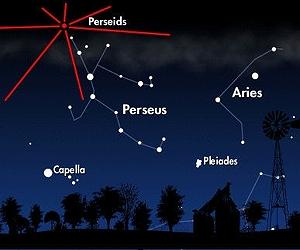
The Perseid Meteor Shower is going to be harder to see in 2009 because of the bright Moon that rises at 10:40 pm in San Francisco. For the city dweller, however, the shower is not much worse because of the bright Moon, as our city lights obscure many meteors anyhow. So the best you can do is simply enjoy the shower the evening of August 11th from wherever you are in the city. Pick a darkened comfortable spot. Lay back on a blanket and point your feet to toward the north
-east and look around the sky. As the evening wears on, the origination point ("radiant") of the meteor shower rises in the north-east. This area is near the constellations Perseus and Cassiopeia as shown in the illustration to the right.
This year there will be a possible jump in the number of meteors as the Earth passes through a denser-than-usual filament of dust from the remnants of comet Swift-Tuttle. That will happen around 1:00 am pacific time on the 12th, so if you are up late you might just see a more intense period of meteor activity. Throughout the entire evening, the Moon will remain the one bright light everyone cannot escape, so when it rises just point your gaze in another direction and keep your eyes on the sky. And stay warm!
If you want to see a good meteor shower this year that won't have moonlight in the way, look ahead to December 14th when the Geminids will peak at an even higher rate than the Perseids. However it will be considerably cooler and the weather is less predictable at that time.
The Perseid Meteor Shower is going to be harder to see in 2009 because of the bright Moon that rises at 10:40 pm in San Francisco. For the city dweller, however, the shower is not much worse because of the bright Moon, as our city lights obscure many meteors anyhow. So the best you can do is simply enjoy the shower the evening of August 11th from wherever you are in the city. Pick a darkened comfortable spot. Lay back on a blanket and point your feet to toward the north
This year there will be a possible jump in the number of meteors as the Earth passes through a denser-than-usual filament of dust from the remnants of comet Swift-Tuttle. That will happen around 1:00 am pacific time on the 12th, so if you are up late you might just see a more intense period of meteor activity. Throughout the entire evening, the Moon will remain the one bright light everyone cannot escape, so when it rises just point your gaze in another direction and keep your eyes on the sky. And stay warm!
If you want to see a good meteor shower this year that won't have moonlight in the way, look ahead to December 14th when the Geminids will peak at an even higher rate than the Perseids. However it will be considerably cooler and the weather is less predictable at that time.
Saturday, January 3, 2009
Resolution for 2009: See more meteor showers
I awoke this morning shortly after 5:00 and dressed warmly to see the first meteor shower of 2009, the Quadrantids. I had just been reading about this shower the night before and it sounded like it would have an impressive peak at 5:00 pacific time. The conditions looked good from inside my house, so I ventured to my backyard and looked high into the north-east. It took only a minute or two before I was rewarded for my efforts: a pinpoint of light streaked across the sky for an instant. I was energized and focused and saw a particularly bright one a minute later. In my brief 15 minute session, I saw about 8 meteors. By then the first light of dawn was beginning to color the eastern sky and I was ready to hop back into bed!
Meteors are a delight from my point of view for a variety of reasons. They are high-speed astronomical events, those rare things you can encounter in the sky that are fast and require you to pay attention, like a total solar eclipse. Meteors are quick and yet they leave the impression of a long trail in your eye (sometimes the long streak is real, but often it is just a visual memory). My favorite thing is that they are silent. I always expect them to make a sound like an exploding firework, but despite the fact that we are witnessing mass vaporizing in an explosion of heat and brightness, nearly all meteors make no sound. The occasional fireball that is of massive proportion (such as a recent fireball over Canada) are the extremely rare spectacles that might create some local sound.
Meteor showers are annual events that are specifically tied to a time of year and a location in the sky from which the meteors all appear to radiate. For 2009, I am going to make a point of seeing more of these. Typically meteor showers peak after midnight and are best seen when there is no interference from the moon. So for the 10-12 major showers that occur in a year, the phase of the moon will make some of them easier to see than others. Of course, weather plays a role like it does for any other astronomical viewing - the clearer the atmosphere, the better the viewing. And of course the darker the sky, the more meteors you will see. Last night was a chance alignment of nearly all these factors: no clouds, clear atmosphere and no moon. So I jumped at the opportunity to enjoy the sight of the Quadrantid meteors. Even in the city lights of San Francisco the conditions were favorable enough to see some.
The informative astronomy website EarthSky has an excellent summary of the major meteor showers in 2009. Mark your calendar and plan to see a few - they are truly beautiful to witness.
Subscribe to:
Posts (Atom)