Showing posts with label Perseus. Show all posts

Tuesday, October 12, 2010

An Elusive Comet in Urban Skies: Hunting for Hartley 2

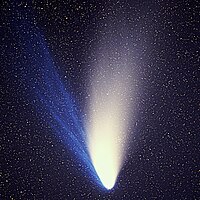
Comets can be bold and brash, streaking across the sky like Hale-Bopp in 1997 (see image on right), a comet that was visible even in light-polluted urban areas. Comets can be more humble but then unexpectedly brighten, as did Comet Holmes in 2007. This year marks the return of periodic Comet Hartley 2, a small but frequent visitor to the inner Solar System that is making a fairly close pass to the Earth (11 million miles) on October 20th. Because of the bright Moon on October 20th, this and last week mark the best chances to see the comet because the Moon is young and not brightening the sky. So I took a look last week and again this week to see if I could spot this elusive comet from a city location (last week in a suburb of Frankfurt, Germany and this week from my home in San Francisco).

I hunted quite a while on both occasions, using this very helpful map from Sky and Telescope Magazine. In fact, S&T has been running updates as viewers report seeing Comet Hartley 2 with binoculars. However, it seems that to see Comet Hartley 2 you need a location with very dark skies. I can attest to this, having twice tried and failed to discern the comet from the surrounding stars.

However, all is not lost. Searching for Hartley 2 requires you to find Cassiopeia, Perseus and Auriga, three very nice constellations that grace the Fall and Winter skies. While searching the path of the comet, you encounter a range of deep space objects near and between Cassiopeia and Perseus, and tonight the view was quite good. So even though city lights may have drowned out the faint comet, I enjoyed my first good look at the Double Cluster in Perseus and other celestial gems in the spiral arm of the Milky Way that is beyond Cassiopeia.

I recommend a good jacket, a comfortable chair or blanket, a few minutes patience, the S&T sky map, and binoculars. No matter whether your hunt for Comet Hartley 2 is a success or not, you will be glad you made the effort.

Wednesday, August 11, 2010

Perseid Meteor Shower 2010

The Perseid Meteor Shower reaches its peak this week and the timing is very good for a fine display of meteors. Every year when the Perseids come around, the biggest concern is the Moon. Its beautiful light is a welcome sight to many, but for amateur astronomers and anyone wishing to see more than a few meteors, moonlight can ruin an otherwise-perfect evening of viewing. This year the Moon is very young during the Perseids and sets not long after sunset, leaving a dark sky for the shower.

The Perseids peak on the nights of Thursday 12th and Friday 13th, with best viewing on Thursday night / Friday morning. You can get detailed information on the Sky and Telescope website or on numerous other web resources.

The best way to see the meteor shower is to find a dark location, give your eyes plenty of time to adapt to the darkness, and be prepared to stay up late (or get up early). Meteor showers are almost always best viewed after midnight when the Earth is powering directly into the meteor stream and the rate increases substantially. The Perseids appear to originate in the constellation Perseus which is in the east after midnight, but that does not mean you have to specifically look east to see the meteors. Lying on a blanket facing directly overhead gives you the most expansive view and you can see meteors coming from the east or passing overhead toward the west. Meteors are wonderful, fast, elusive wonders and you simply need to be warmly dressed, in a place where you can see as much of the sky as possible without light distractions, and patience. I wish you clear skies and a great night or two observing.

Monday, August 10, 2009

Perseid Meteor Shower 2009

It's August and that means its time for the annual Perseid Meteor Shower, this year reaching its peak on the evening and through the morning of August 11-12. Meteors are visible just about any night of the year, but throughout the year there are periods of intense activity in the sky ("meteor showers") because the Earth travels through a point in its orbit where there is a higher amount of space dust, rocks and other particles that enter the atmosphere at tens of thousands of miles per hour and burn up, creating bright streaks across the sky.

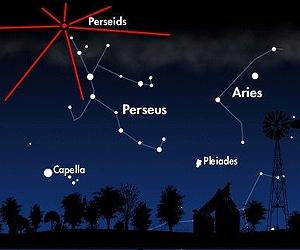
The Perseid Meteor Shower is going to be harder to see in 2009 because of the bright Moon that rises at 10:40 pm in San Francisco. For the city dweller, however, the shower is not much worse because of the bright Moon, as our city lights obscure many meteors anyhow. So the best you can do is simply enjoy the shower the evening of August 11th from wherever you are in the city. Pick a darkened comfortable spot. Lay back on a blanket and point your feet to toward the north-east and look around the sky. As the evening wears on, the origination point ("radiant") of the meteor shower rises in the north-east. This area is near the constellations Perseus and Cassiopeia as shown in the illustration to the right.

This year there will be a possible jump in the number of meteors as the Earth passes through a denser-than-usual filament of dust from the remnants of comet Swift-Tuttle. That will happen around 1:00 am pacific time on the 12th, so if you are up late you might just see a more intense period of meteor activity. Throughout the entire evening, the Moon will remain the one bright light everyone cannot escape, so when it rises just point your gaze in another direction and keep your eyes on the sky. And stay warm!

If you want to see a good meteor shower this year that won't have moonlight in the way, look ahead to December 14th when the Geminids will peak at an even higher rate than the Perseids. However it will be considerably cooler and the weather is less predictable at that time.