Showing posts with label binoculars. Show all posts

Wednesday, October 12, 2011

Brilliant Moon and Jupiter

The Full Moon dominates the night sky this week, lighting the Autumn landscape and making its presence known as the soft grey glow of moonlight washes out all but the brightest stars in the sky. But even as the stars take a back seat in the night sky, the giant planet Jupiter shines steadily next to the Moon, undiminished by the intense glow of our nearest celestial neighbor.

Jupiter is nearing "opposition" in which it is at its closest approach to Earth for 2011. That means that it is also at its brightest, outshining all other celestial bodies in the night sky right now, except the Moon. For the next few nights as the Hunter's Moon passes near Jupiter, your attention will be drawn to the dazzling brightness of the largest planet in the Solar System. And once the Moon has moved into Last Quarter phase next week, Jupiter will remain steadfast in the evening sky, waiting for you to find it in binoculars or a small telescope. Take a moment and look up close if you have not seen Jupiter up-close. It's a worthy (and easy) target.

Image courtesy of Sky & Telescope Magazine.

Friday, May 6, 2011

Venus, Jupiter, Mars and Mercury in Conjunction

Four of the five most-visible planets are bunched together in the morning sky, creating beautiful patterns along the eastern horizon at dawn for the next few weeks. Each day the four planets change slightly in position, with bright Venus guiding your eyes to the right spot on the horizon where you can see these four points of light. Use binoculars to find all four planets - Mercury and Mars are much fainter than Jupiter and Venus - and use this amazing animation on the Sky & Telescope website to find the exact pattern as it changes each day. In San Francisco, you will want to look for this between 5:00 and 5:30 am, before the glare of the sunrise washes out the view of the planets.

Monday, April 4, 2011

The Moon and two Star Clusters: Pleiades and Hyades

The Moon graces the last vestiges of the winter sky this week, as the waxing Moon splits two of the prettiest star clusters, the Pleiades and the Hyades. This will be an exciting sight for stargazers, one that will look particularly magical through binoculars. So mark your calendar for Thursday April 7th and watch the show unfold all week long.

When the Moon emerges from the New phase and starts its 29 1/2 day journey around the Earth, the first few days are always a treat, because the waxing crescent offers so much to see through a telescope or binoculars, and even without optical aid, the sight of the thinly-lit Moon and the glow of Earthshine always catch your eye.

On Thursday, the Moon moves past the Pleiades star cluster, one of the best known clusters in the sky because the stars in it are fairly bright and concentrated into a small space, creating a kind of glow in the sky. Around the bright star Aldeberan in Taurus is the open cluster called the Hyades. These stars are also a close grouping in the sky, but not as tightly arranged, so you don't get the same kind of glow. However, through binoculars this cluster offers much to see.

Use the graphic (above) to help you orient yourself this week. You will want an observing location with a clear western horizon, away from streetlights or other distractions, and good weather. If you get all these conditions just right, you have no excuse for missing this gem of a celestial lineup. And if you live in San Francisco, come join me at the Cal Academy for a personal tour :-)

Sunday, April 25, 2010

A Beacon in the Twilight

As the days grow longer and the last vestiges of twilight linger later in the evening, look to the West this week for some very beautiful planetary/celestial lineups. The week features fast-moving Venus passing very near to some of the most spectacular star clusters in the night sky, the Pleiades and the Hyades.

When you look into the twilight sky, the brightest objects shine majestically against the bright blue background. That is the case for Venus this week, as it is for the young crescent Moon each month when it shines low in the West in the first few days after new Moon. However, in order to see the star clusters near Venus, you will need to use binoculars. The stars are there to see, but the bright twilight makes them all but invisible to the naked eye. It's worth the time to get out and see this spectacle. Sunset in San Francisco is just before 8:00 pm, and the sky will be dark enough about 45 minutes to an hour after that.

Sunday, November 1, 2009

Close Encounter of the Pleiades and Moon

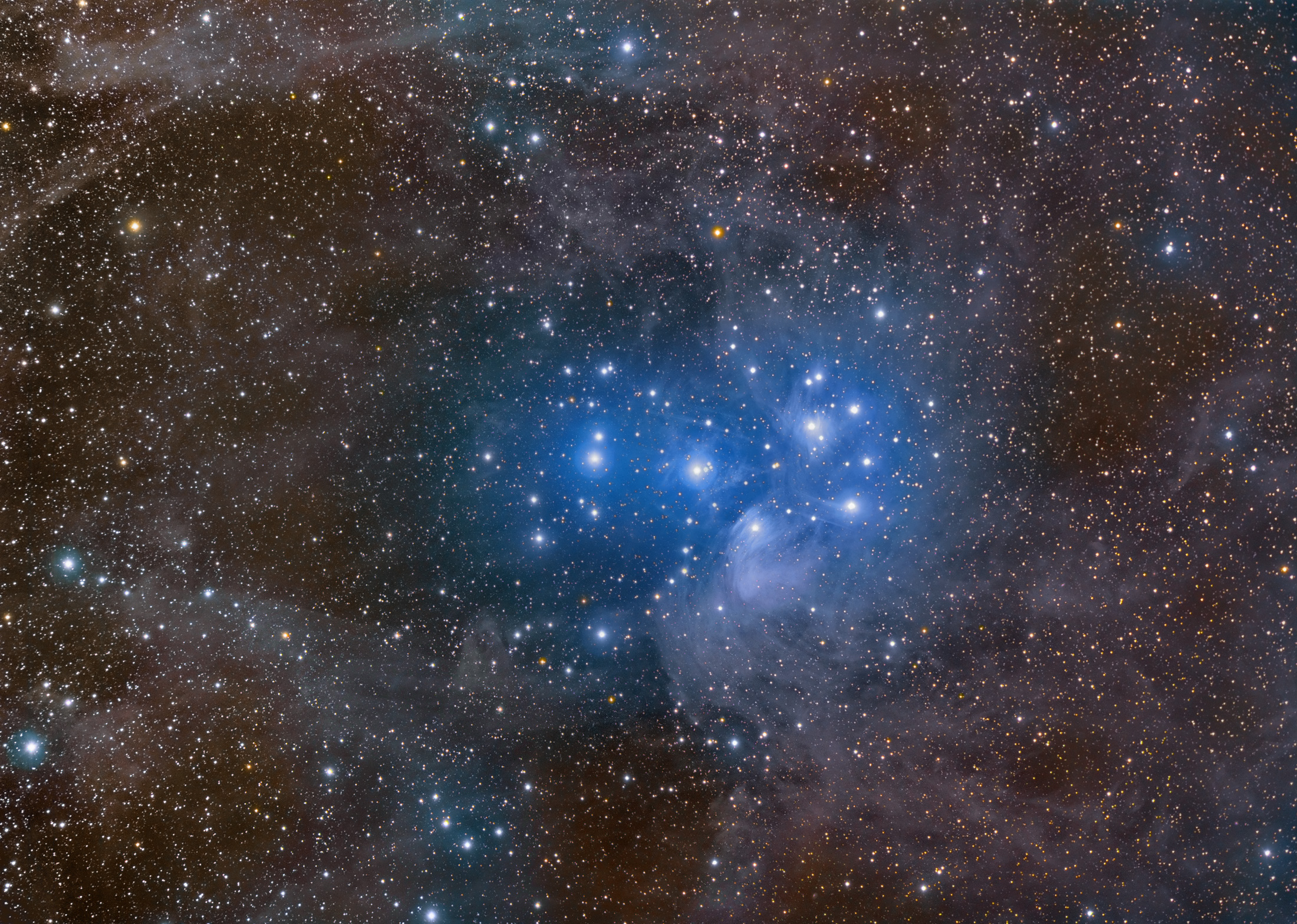
The Pleiades is one of the most beautiful star clusters in the sky. In Autumn it rises during the evening and its distinctive glow shines even for urban dwellers. The Pleiades, also known as M45 (from the Messier Catalog), is a collection of relatively young stars (only 100 million years old!) that shine with a blue color due to their hot temperature. The Pleiades are also known as the Seven Sisters and there is plenty of mythology describing each of the seven sisters. Despite the "Seven Sisters" mythology, most people see six stars when they look out at the Pleiades and describe the shape of the asterism as a small Little Dipper. Random fact: the Subaru car company logo is made up of six the stars, Subaru being the Japanese term for Pleiades.

This week on Tuesday evening the full moon passes very close to the Pleiades and in more southerly latitudes it actually occults (blocks out) several of the brightest stars in the cluster. For those of us in San Francisco, the evening of November 3rd should be especially interesting if you view the Moon through binoculars or a telescope. You will be able to notice how fast the Moon moves past the stars of the Pleiades. Although the very bright light of the full Moon will drown out nearly everything around it (including the blue nebulosity of the dust surrounding the Pleiades), all will be clear when you look closely with binoculars or a telescope.

Sunday, October 25, 2009

Jupiter and the Moon dominate the sky

For the next few evenings Jupiter and the Moon put on a show as they brighten up the southern sky. Jupiter is in Capricornus moving gradually eastward across the constellation. The Moon, just past first quarter phase, is also speeding across Capricornus and will appear very near to Jupiter on Monday evening October 26th.

Jupiter will remain a brilliant light high in the southern sky for the remainder of 2009. I enjoy the close-up view of the planet through a telescope or binoculars because you can see the four Galilean satellites, moons that are big enough to see with just 10 or 20x magnification, moons that move so quickly that you can detect the change of position of the four Galilean moons with respect to each other in just one evening of watching.

Monday, August 24, 2009

The Milky Way and the Galactic Center

At the SFAA star party a couple nights ago on Mt Tam, the conditions were very clear and dark and we had a nice view of the Milky Way. With an excellent southern horizon, we could see all of Scorpius and Sagittarius and as my daughter and I were giving star tours to guests at the star party, I was happy to point out these two constellations and note that the center of the Milky Way was in the vicinity of the tail of Scorpius and the "teapot" of Sagittarius. This is called the "Galactic Center" and is the central bulge of the Milky Way Galaxy.

Looking toward the galactic center, however, you don't see a huge ball of light. That is because there is a massive dust cloud that lies between the Sun and the galactic center. Too bad for us, because it would be quite amazing to see the center of our own galaxy. Nonetheless, there is much richness in the sky near the galactic center and even in city lights you can begin to see some of that beauty if you use a pair of binoculars. Standard 7x35 or 10x50 binoculars can substantially increase the amount of light you can see, and that means you can begin to discern the stars and shapes of deep space objects such as the Lagoon Nebula or the Swan Nebula. Take out binoculars and point yourself south and see if you can start to see some of the wonders that are at the heart of the Milky Way.