Showing posts with label Mars. Show all posts

Wednesday, November 30, 2011

Viewing all 5 Visible Planets in one night

As the nights grow longer and the skies darker, we have the chance for the next few weeks to see all five planets visible to the naked eye in a single night. Of course, there are seven planets in our Solar System (not including Earth), but two (Uranus and Neptune) are just too faint to see without optical aid. However, the rest (Mercury, Venus, Mars, Jupiter and Saturn) are spread around the entire sky, adding a lot of brightness to our already-shiny Autumn and Winter skies. This article in the science blog EarthSky is an excellent guide to help you find each planet. Of course, to find Jupiter and Venus you need little guidance because they are so bright, but Mercury, Saturn and Mars will be easier to find with some assistance from a sky map.

And if you are ready to look deeper and see all 7 in one night, here is a chart to guide you to Uranus and Neptune. They are both just west of Jupiter, in the constellations Pisces and Aquarius.

Image courtesy NASA.

Friday, September 30, 2011

Mars passes through a star cluster, the Beehive

Our fellow planets in the Solar System are on the go, always wandering from place to place in the sky. The rocky planets (Mercury, Venus, Mars) move quickly, due to their closer proximity to the Sun, and their motion from day to day can be noticeable to the naked eye. The gas giant planets (Jupiter, Saturn, Uranus, Neptune) move more gradually but are nonetheless regularly moving against the backdrop of stars.

Mars, being our 2nd-closest Solar System neighbor, can appear to move quite considerably against the backdrop of stars from one night to the next. This week, it will pass through the constellation Cancer and in doing so, travel through one of the most well-known star clusters in the heavens, the Beehive Cluster. This will be a fine site even in city skies, but you will need binoculars to truly appreciate the view. Use the diagram to find this spectacle in the early morning sky, looking due east (just as I can see when I walk out my front door in the morning). Enjoy!

Image courtesy of Sky & Telescope Magazine.

Sunday, June 26, 2011

The Moon amid planets and star clusters

The morning sky this week will be rich with easy-to-spot celestial objects in the hour before sunrise. Find a good view toward the eastern horizon and use binoculars to enhance the view of Venus, Mars, the waning crescent Moon and two of the finest star clusters in the sky, the Pleiades and Hyades. I am looking forward to it!

Monday, May 16, 2011

Planetary Lineup on May 21st

With all of the talk about May 21st, I felt it would be helpful to guide observers to a genuine, heavenly lineup that will create a beautiful pattern in the morning sky on the 21st and 22nd. During the entire month of May, the four nearest planets to Earth have been creating a beautiful sight in the morning sky just ahead of sunrise. On May 21st and 22nd, Mars, Mercury and Venus form a compact cluster. Bright Venus is the "guide star" to help you find this grouping in the east. You will want to look about 30-45 minutes before sunrise, and you will need binoculars to see Mercury and Mars, but Venus will shine brightly despite the glare of the soon-to-be-rising Sun. Jupiter is also quite visible in the sky, but each day pulls away to the upper right (toward the south-east) a bit more from the other three planets. Note that the image of the view toward the east, which comes courtesy of Sky & Telescope Magazine, demonstrates that astronomers are confident we'll have something to see the morning of the 22nd!

Friday, May 6, 2011

Venus, Jupiter, Mars and Mercury in Conjunction

Four of the five most-visible planets are bunched together in the morning sky, creating beautiful patterns along the eastern horizon at dawn for the next few weeks. Each day the four planets change slightly in position, with bright Venus guiding your eyes to the right spot on the horizon where you can see these four points of light. Use binoculars to find all four planets - Mercury and Mars are much fainter than Jupiter and Venus - and use this amazing animation on the Sky & Telescope website to find the exact pattern as it changes each day. In San Francisco, you will want to look for this between 5:00 and 5:30 am, before the glare of the sunrise washes out the view of the planets.

Sunday, April 17, 2011

Five Weeks of Planets in Conjunction

We are entering a period of time in which several planets are going to be in close proximity to each other, creating special alignments called "conjunctions." Mars, Mercury, Jupiter and Venus are all occupying the same region of the sky from our Earth-bound point of view, and as these planets and our own planet are all in motion around the Sun, the pattern we see in the sky changes quite a bit from one night to the next. At this time, all of these planets are emerging from the glare of the brightening dawn sky, appearing in the east just minutes before sunrise. Therefore, the initial conjunction on April 19th is best visible with the aid of binoculars. But this is just the start of a five week period in which these planets move very close to one another, creating a beautiful series of patterns for the early morning observer.

Our planet moves nearly 2 million miles per day in its orbit around the Sun. The planets are also moving at high speed around the Sun in their respective orbits. Mercury and Venus move the fastest relative to Earth, and because of their unique position inside the orbit of Earth, we see their changing locations in the early morning just before sunrise, or in the evening just after sunset. The other planets, including Mars and Jupiter for the next few weeks, move more slowly from our point of view and move more steadily from east to west from one morning to the next. I'll be posting a regular series of updates over the next month as the various conjunctions come and go. The important thing for the observer is to find a good eastern horizon, dust off the binoculars, and be ready to get up just before sunrise to see these cosmic alignments.

Monday, August 23, 2010

Perspective of the Solar System

After weeks of foggy skies in San Francisco, the sky has started clearing, yielding spectacular sunsets and sky shows at Ocean Beach. I have been writing about (but not seeing much of) the amazing sight of the planets dancing across the evening sky. With the clear skies, the view was great, showcasing Venus and Mars very close together, with Saturn just to the lower right and the bright Zodiac start Spica (in Virgo) just to the upper left.

This configuration traces a curve in the sky and if you have a clear southern horizon you can "connect the dots" from this cluster of stars and planets to the south where bright Jupiter dominates the sky. Beyond that, the Moon is slicing across the lower southern sky, providing the observer with a nice visual of the Ecliptic, the line of the planets, Moon and Sun. This is a great way to visualize the path of the planets in the Solar System when you look out from our Earth-bound perspective.

Over the coming months, Mars and Saturn and eventually Venus fade, but the giant planet Jupiter will be dominating the Fall skies.

Monday, August 2, 2010

Trio of Planets

The evening sky brings us a trio of planets in a close grouping this week. The bright beacon of light, Venus, shines brightly and moves quickly from night to night, especially by comparison to the slower-moving Mars and Saturn. The image shows the view on Sunday August 8th, so looking at this earlier in the week you will find Venus lower and to the right of the other two planets, and after the 8th you will see Venus glide to the upper left of the two planets. We are witnessing the motion of Venus along its orbit around the Sun, moving much more quickly from our vantage point on Earth than Mars and Saturn. Venus will continue to dominate the evening sky for many weeks to come.

Sunday, July 11, 2010

A Must See: Four Planets and the Moon

This week the sky features four of the brightest planets in a beautiful lineup in the sunset sky. The illustration on the left, borrowed from Sky & Telescope Magazine, demonstrates how the planets all align themselves in a path across the sky known as the Ecliptic. This line in the sky, actually a gentle curve from west to east across the south part of the sky, is the plane of the Solar System as viewed from our observing platform on Earth. We see fast-moving Mercury close to the Sun, then Venus, Mars and Saturn, a most impressive line-up.

To set this into perspective, the young Moon emerges from the glare of the Sun on Tuesday 13th, moving somewhat parallel to the Ecliptic but each day a bit farther south of the Ecliptic. This is because the orbit of the Moon around the Earth is slightly inclined to the rest of the bodies in the Solar System. And as we just had a Total Solar Eclipse on Sunday, the Moon is following a path away from the Ecliptic into what is called the "descending node" south of the Ecliptic.

I will be talking about this at the California Academy of Sciences at their Nightlife event this Thursday in Golden Gate Park. If you are in or near San Francisco, please join me on the roof for Star Tours!

Monday, July 5, 2010

Star-and-Planet Drama

The evening sky over the next few weeks offers a study in the changes that take place in the sky along the path of the Moon and the path of the planets. This is exciting to watch and helps to unveil some of the intricacies of the Solar System, something you can see right from your own backyard. For quite a while now I have been particularly fond of sharing the path of the planets across the sky (the "Ecliptic") while conducting star parties and giving astronomy talks. I find that the ability to visualize this band across the sky is an important one for those who wish to have a basic understanding of the motion of the planets across the sky. And for several months the bright planets, a collection of bright stars, and the monthly sweep of the Moon across the sky have provided a perfect laboratory for learning. This month is no exception.

Shortly after sunset there is an excellent parade of planets and stars easily visible as the glare of dusk fades, starting with brilliant Venus in the west, and then in succession from west to south are Regulus, Mars, Saturn and Spica. These bright objects show the line of the Ecliptic.

At the end of this week there is a total solar eclipse (unfortunately not visible
from the San Francisco Bay Area). The eclipse comes at the middle of an Eclipse Season and as such, the Moon follows a descending path below the Ecliptic in the days that follow the eclipse, in particular from the 12th to the 17th of July. As it moves from day to day, it swoops just below the Ecliptic and makes a pleasant arc across the southern sky below Venus and Regulus, then Mars, then Saturn and then Spica.

And in addition, we are just coming into a period of time when fast-moving Venus has close encounters with the other planets and stars along the Ecliptic, starting with a close encounter of Regulus on the 9th of July. More drama to come in the next few weeks -- stay tuned!

Saturday, May 8, 2010

Planets and Bright Stars along the Ecliptic

This is a great time of year to enjoy the view of bright stars and planets demarcating the ecliptic. I am hosting a lot of star parties these days (last week in Tomales, this week in Fremont, next week in Healdsburg and the week after in San Mateo) and I always love to point out the ecliptic, the band across the sky where the planets and Moon are found in their wanderings across the heavens.

The ecliptic is the plane of the Solar System, the imaginary line across the sky that marks the orbits of the planets and the Moon. In a planetarium this can easily be shown, but under the heavens it is daunting to visualize this. I use a laser pointer to show the path across the sky, and that helps to visualize this, but right now the skies are cooperating to make this a bit easier for those of you without an amateur astronomer and a laser pointer :-)

Face South about 30-45 minutes after sunset and you will be looking toward the ecliptic. It stretches from the point of sunset to your right (West) where bright Venus gives you one reference point, then stretches up and toward the south to Castor and Pollux, the two twin stars of the zodiac constellation Gemini. Just to the upper left of the pair is bright orange Mars, and continuing left you encounter blue-white Regulus, the brightest star in the zodiac constellation Leo. Now the line of the ecliptic moves down toward the East, that is, down and to the left as you face South. Lower left of Leo is the planet Saturn, a bright, milky-white dot of light. And continuing to the lower left of Saturn is the bright star Spica, in the zodiac constellation Virgo.

Enjoy the tour, and if you have a star chart, put it to work so you can use these bright points of light to help you learn a few constellations. Even in the big city, all of these are visible.

The image on this page was copied from Nick Strobel's Astronomy Notes. Go to his site at www.astronomynotes.com for the updated and corrected version.

Friday, April 9, 2010

Mars and the Beehive

Over the past few weeks I have been watching the gradual change in position of Mars as it moves from retrograde to prograde motion across the sky, now moving steadily eastward across the constellation Cancer and next to a beautiful cluster of stars knows as the Beehive Cluster, or M44.

Mars, like all other planets, moves eastward from our point of view most of the time but when Earth have just the right alignment (as we did with Mars over the last few months) a planet may appear to travel westward, and we call this motion "retrograde." Click on the image to see how Mars was in retrograde from December through March.

Now that Mars is moving eastward again, it is traversing a part of the constellation Cancer where you can find the Beehive Cluster, an open cluster of stars (like the nearby Hyades cluster in Taurus). It is relatively close to the Solar System compared to most clusters, and it is a gem in binoculars. With Mars as your guide "star" you can easily navigate to the Beehive Cluster high overhead this time of year. It's worth a few minutes to see if you can spot it.

Tuesday, February 23, 2010

Winter Sky Show: Gemini, Mars and the Moon

Gemini is one of the finest constellations you can see during the winter months, easy to spot because it traverses the highest spot in the sky (the zenith) and features two bright stars, the twins Castor and Pollux. These two stars are well known because they symbolize the heads of the mythical twins. The stars that make up the rest of the bodies of the twins are less bright and require slightly darker conditions than we will have this week, but I provide an image nonetheless so you can see the rest of the stars when conditions permit.

Mars is the bright orange beacon of light that is gracing the night sky, the brightest object high in the sky for the next many weeks. As Mars orbits the Sun, we observe it moving against the backdrop of the Zodiac constellations, changing its position gradually from month to month as it travels eastward from our Earthbound perspective (this is called prograde motion, in contract to retrograde motion – more on that in a future post). It is about to start moving away from the twins of Gemini through Cancer toward Leo the Lion where it will arrive in May.

The Moon sweeps through this busy part of the sky, passing slightly south of Gemini, Mars and later this week the bright star Regulus in the constellation Leo. The bright Moon will drown out the background stars of these otherwise bright constellations, but the prominent stars Castor, Pollux and Regulus, along with Mars, will shine beside the waxing gibbous Moon. Binoculars or a telescope are a good idea if you want to see this close up!

Monday, February 1, 2010

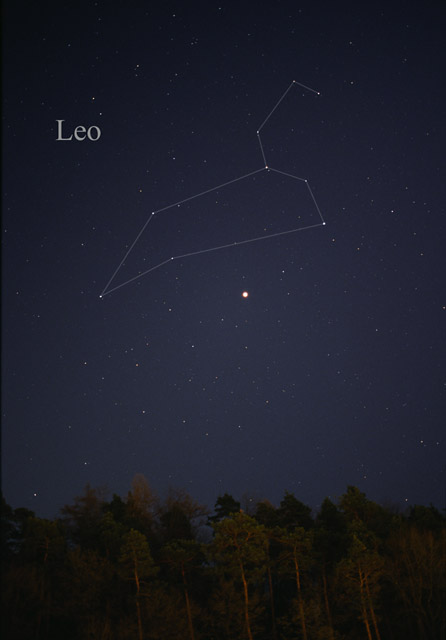
Leo the Lion

Leo is one of the twelve zodiac constellations, the name "zodiac" sharing its origin with the word "zoo" -- appropriate for the ring of mythical animals found in the sky. Leo is a very easy-to-locate constellation because it has one very bright star (Regulus) and quite a few moderately bright stars in a distinctive pattern that resembles a lion. The image at left shows the general outline of the stars in Leo, with the sickle (or backwards question mark) at the head of the lion, something that is easily identifiable as Leo rises in the east in the winter. For the coming months, it will be appearing higher in the east and traversing nearly overhead throughout the evening.

Because they form a band around the sky that follows the Sun's path, each of the zodiac constellations has frequent visitors as they grace the night sky, from the Moon to the planets. Leo has been the home of Saturn for the last three years, but now Saturn is drifting slowly eastward into Virgo. On the west side of Leo is Mars, currently in retrograde in Gemini, but soon to be speeding toward Leo and a close encounter with the bright star Regulus in June.

Take some time to become acquainted with this celestial Lion, and you'll know how to quickly navigate to Saturn and Mars throughout the spring and into the summer.

Thursday, January 28, 2010

Mars and the Biggest Full Moon of 2010

The next few days offer a chance to see Mars and the full Moon together while each celestial body passes through its closest point to the Earth in their orbit. When Mars and Earth line up in their orbits around the Sun, we call that "opposition" and it represents the closest approach between the two planets. This takes place approximately every two years and when it does, Mars appears brighter than usual and is larger in a telescope. Also at opposition, Mars rises just as the Sun sets and is up all night. Mars is at opposition on Friday January 29th.

The Moon has an elliptical orbit around the Earth and as such, each orbital period (approximately 29 days) it is a bit closer to Earth (called Perigee) and then a bit farther from Earth (called Apogee) This month, the Moon is full and is at Perigee on the same date, Friday January 29th. It is also next to Mars so when you look outside on Friday evening, you'll be seeing a nice lineup of a couple of our nearest neighbors. When the Moon is at Perigee, it is a considerably bigger object in the sky than usual. The website Spaceweather.com highlights this nicely in their article.

I have written about the biggest full moon of the year in a previous blog post, if you want to get more information about that subject.

Regarding Mars and opposition, there was a great deal of hype in August 2003 when Mars had a particularly close opposition and was inaccurately stated as "being as big as the Full Moon." That won't ever happen, of course, but it certainly inspired a lot of people to take a look at Mars that summer. This week Mars will be less bright and big compared to 2003 but still a worthy binocular or telescope target. The next close encounter that will rival the 2003 lineup will be in 2018. For an extremely detailed chart and description of the Mars opposition phenomenon, visit the seds.org site.

Friday, January 1, 2010

Mars arrives in the evening sky

Mars is back on display, now visible shortly after sunset in the eastern sky. During the month of January it will reach "opposition" when it appears exactly opposite the Sun in the sky. At opposition Mars is also at closest approach to Earth (and is therefore at its brightest for the year). It shines a distinctive red-orange color especially when compared to the stars in Leo and Cancer that surround it. Through binoculars or a telescope Mars appears as a small colorful dot of light. This week the Moon serves as a guide for locating Mars.

Wednesday, July 15, 2009

Moon, Pleiades, Mars and Venus

The next few mornings provide a great chance to see close alignments of planets, the Moon and the easy-to-spot, beautiful star cluster known as the Pleiades. Click on the illustration (at the right) for a detailed view of the spectacle in the eastern pre-dawn sky, especially the changing location of the Moon each morning as it wanes from last quarter to a thin crescent.