Showing posts with label Cancer. Show all posts

Friday, September 30, 2011

Mars passes through a star cluster, the Beehive

Our fellow planets in the Solar System are on the go, always wandering from place to place in the sky. The rocky planets (Mercury, Venus, Mars) move quickly, due to their closer proximity to the Sun, and their motion from day to day can be noticeable to the naked eye. The gas giant planets (Jupiter, Saturn, Uranus, Neptune) move more gradually but are nonetheless regularly moving against the backdrop of stars.

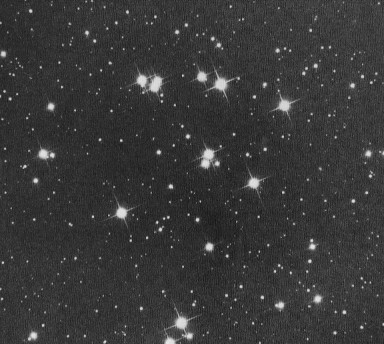
Mars, being our 2nd-closest Solar System neighbor, can appear to move quite considerably against the backdrop of stars from one night to the next. This week, it will pass through the constellation Cancer and in doing so, travel through one of the most well-known star clusters in the heavens, the Beehive Cluster. This will be a fine site even in city skies, but you will need binoculars to truly appreciate the view. Use the diagram to find this spectacle in the early morning sky, looking due east (just as I can see when I walk out my front door in the morning). Enjoy!

Image courtesy of Sky & Telescope Magazine.

Friday, April 9, 2010

Mars and the Beehive

Over the past few weeks I have been watching the gradual change in position of Mars as it moves from retrograde to prograde motion across the sky, now moving steadily eastward across the constellation Cancer and next to a beautiful cluster of stars knows as the Beehive Cluster, or M44.

Mars, like all other planets, moves eastward from our point of view most of the time but when Earth have just the right alignment (as we did with Mars over the last few months) a planet may appear to travel westward, and we call this motion "retrograde." Click on the image to see how Mars was in retrograde from December through March.

Now that Mars is moving eastward again, it is traversing a part of the constellation Cancer where you can find the Beehive Cluster, an open cluster of stars (like the nearby Hyades cluster in Taurus). It is relatively close to the Solar System compared to most clusters, and it is a gem in binoculars. With Mars as your guide "star" you can easily navigate to the Beehive Cluster high overhead this time of year. It's worth a few minutes to see if you can spot it.

Friday, January 1, 2010

Mars arrives in the evening sky

Mars is back on display, now visible shortly after sunset in the eastern sky. During the month of January it will reach "opposition" when it appears exactly opposite the Sun in the sky. At opposition Mars is also at closest approach to Earth (and is therefore at its brightest for the year). It shines a distinctive red-orange color especially when compared to the stars in Leo and Cancer that surround it. Through binoculars or a telescope Mars appears as a small colorful dot of light. This week the Moon serves as a guide for locating Mars.