Showing posts with label Solstice. Show all posts

Tuesday, December 14, 2010

Total Lunar Eclipse of December 20, 2010

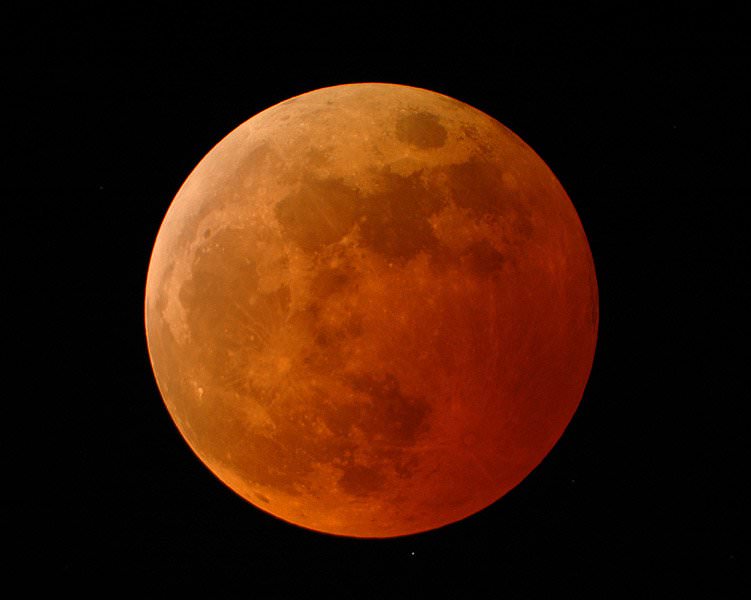
Monday night December 20th, we get to witness a very exciting astronomical spectacle, a Total Lunar Eclipse. This one promises to be a special one, capping the longest night of the year with the strange and beautiful view of the full Moon being blotted out by the shadow of the Earth. The geometry of an eclipse is fairly textbook, but the experience is quite dramatic.

This eclipse will be visible from the western hemisphere, meaning that anyone on the entire night side of Earth will have a view of the full Moon and will see the phases of the eclipse. In this particular eclipse, the Moon passes through the darkest part of the Earth's shadow (umbra) meaning that the entire surface of the Moon will no longer have direct sunlight shining on it, but because of the atmosphere of the Earth, refracted rays of sunlight will in fact bend around the Earth and illuminate the Moon, creating a trademark orange or reddish color on the Moon, an eerie effect indeed. The excellent NASA Eclipse Website has much more detailed information on the eclipse.

The event starts at 10:33 pm in San Francisco, as the partial phases of the eclipse take about an hour. The period of "totality" when the entire surface of the Moon is dark, lasts about an hour from 11:41 pm until 12:53 am, and then the Moon is slowly revealed again for another hour. Cross your fingers for good weather, dress warmly, and enjoy this fascinating spectacle of nature. And if you have binoculars or a telescope, use them - this is exactly the time to get a close-up look at one of the wonders of the sky.

Image courtesy of the Universe Today.

Wednesday, September 22, 2010

Autumnal Equinox and the rate of change of the length of the day

Today is the Autumnal Equinox, one of two Equinoxes of the year. These are days that mark the transition from one season to the next, but also are days that have very special significance as the Earth orbits the Sun. Because of the tilt of the Earth's rotational axis, the Northern and Southern Hemispheres receive radically different amounts of sunlight from June through December, as the seasons progress from Summer to Fall to Winter (northern hemisphere). This is well understood and we learn from basic science courses that the in-between points while transitioning from Summer to Winter, for example, are the days that have equal periods of the Sun above the horizon and below the horizon -- equal duration of night and day -- hence Equinox. Today, everywhere on the planet, the Sun spent exactly 12 hours above the horizon and 12 below, and the Sun rose due East and set due West. From now through March, the Sun will be above the horizon more than 12 hours a day in the Southern Hemisphere, and less than 12 hours a day in the Northern Hemisphere.
I love the symmetry and simplicity of the Sun's motion on this day. It marks a transition as the days are getting shorter in the Northern Hemisphere. Everyone can feel the shortening of the days and sense, innately, that the changes in daylight and darkness are sudden and surprising. This is another fascinating change happening at the Equinox, more subtle but no less fascinating to me. When people sense the changes to the onset of darkness in the evening or the late sunrise in the morning, they are noticing that the length of the day is changing quite quickly and they feel that the times of day that might have been bright and sunny only a few weeks ago are now getting dark. At the time of the Equinox, the length of the day is changing most rapidly. For example, here in the San Francisco Bay Area, the longest day in summer is nearly 15 hours long and in winter the shortest day is approximately 9 1/2 hours. As the seasons change, the time of sunset and sunrise changes slowly, starting at the solstice in June - maybe only 1/2 to 1 minute per day. But then the changing becomes more rapid approaching the Equinox. At the time of the Equinox this week, the length of a day is changing 3 minutes per day -- that is, about 20 minutes in one week! So if you feel like the length of the days is changing very fast, you are absolutely correct.

The change is even more dramatic the farther north or south you are. For example, in Alaska, the length of the day is changing right now about 5-6 minutes per day, or about 40 minutes in one week! Imagine how that would feel, and it is a natural thing that happens every Spring and Fall. I think it is amazing how much the seasons impact the different geographies of the world, and a little understanding of the natural foundation for these effects is a nice thing to have.

Wednesday, February 3, 2010

Annular Solar Eclipse of 2010

Eclipses are very exciting events, special moments that provide beautiful visual spectacles in the sky. Every year there are typically two to three eclipses of the Sun ("solar eclipses") and two to three eclipses of the Moon ("lunar eclipses"). And for each eclipse the event can be "total" (where the Sun or Moon is fully blocked out), or "partial" where a portion of the Sun or Moon is blocked out, but a portion is still visible.

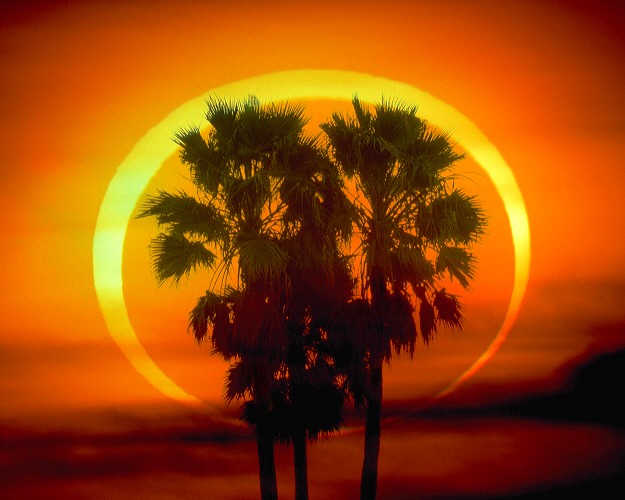
Last month there was one such event, a type of solar eclipse called an Annular Eclipse. In this configuration, the Moon's disk appears to block out most the Sun but does not completely block it out. What makes the Annular Eclipse very special, however, is that the disk of the Moon is fully encircled by the Sun. The eclipse in January was not visible here in San Francisco but was seen in the eastern hemisphere. A fellow astronomy blogger and resident of Sri Lanka, Desh, put together an eclipse page that has video footage of the event and lots of great photographs. He organized a major eclipse viewing event for Sri Lanka.

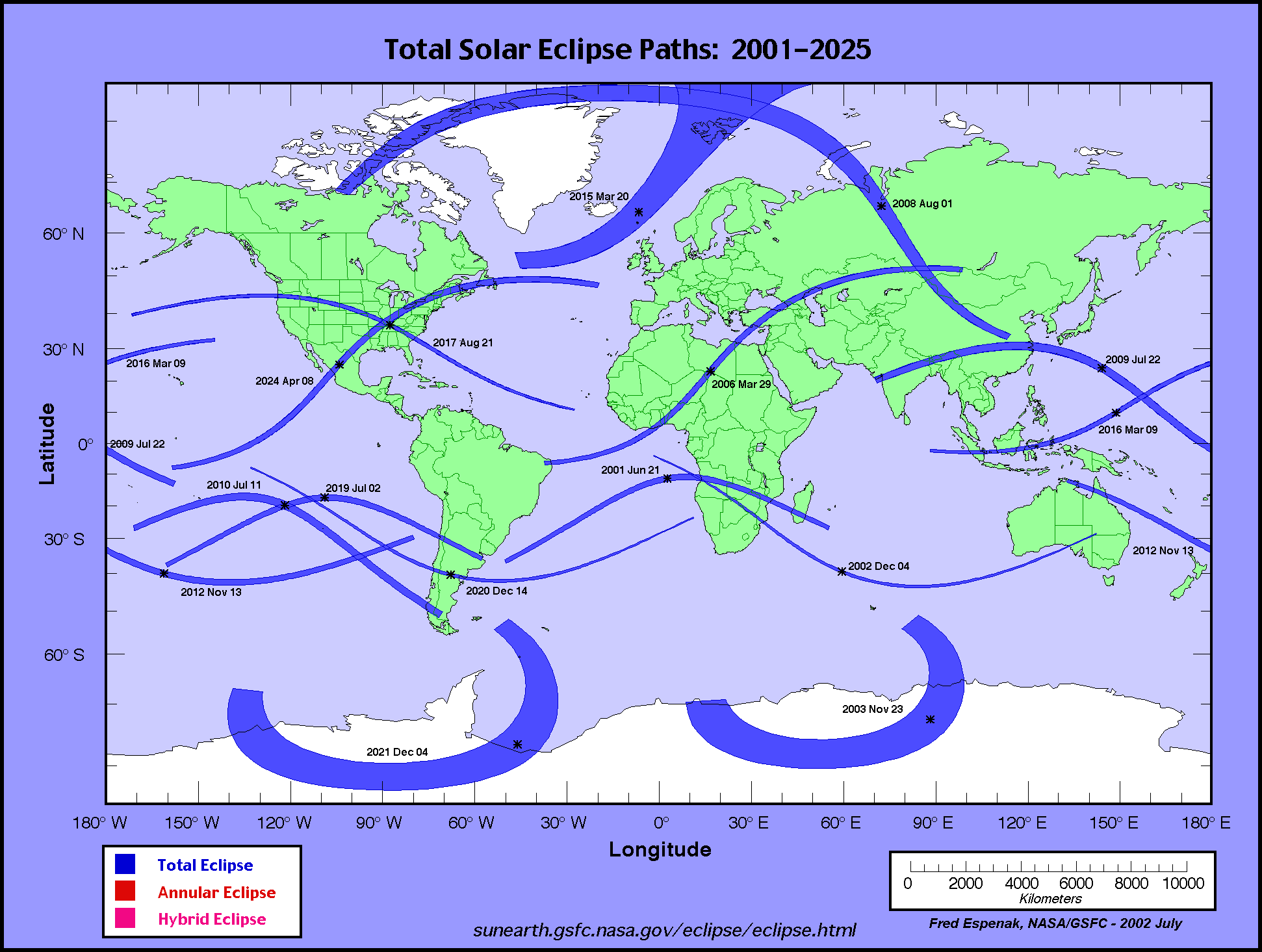
Throughout 2010 there are more eclipses. The biggest event of the year is the Total Solar Eclipse that happens this July 11th, but again will not be visible here in San Francisco. To see this one you will need to travel to the South Pacific. The NASA Eclipse web site is full of details on this and every eclipse and for those of you who want to travel to see a Total Solar Eclipse someday, consult the NASA Total Solar Eclipse Paths map on their website. I think of it as a long-range travel planner!

For those of us in the Bay Area (and the entire Western Hemisphere), mark your calendars for December 21st when we get a beautiful Total Lunar Eclipse on the solstice to welcome in the winter.

Note: for a nice audio description of an eclipse, listen to my recent interview on KALW (just after the stargazing part of the interview).