Showing posts with label Regulus. Show all posts

Monday, July 5, 2010

Star-and-Planet Drama

The evening sky over the next few weeks offers a study in the changes that take place in the sky along the path of the Moon and the path of the planets. This is exciting to watch and helps to unveil some of the intricacies of the Solar System, something you can see right from your own backyard. For quite a while now I have been particularly fond of sharing the path of the planets across the sky (the "Ecliptic") while conducting star parties and giving astronomy talks. I find that the ability to visualize this band across the sky is an important one for those who wish to have a basic understanding of the motion of the planets across the sky. And for several months the bright planets, a collection of bright stars, and the monthly sweep of the Moon across the sky have provided a perfect laboratory for learning. This month is no exception.

Shortly after sunset there is an excellent parade of planets and stars easily visible as the glare of dusk fades, starting with brilliant Venus in the west, and then in succession from west to south are Regulus, Mars, Saturn and Spica. These bright objects show the line of the Ecliptic.

At the end of this week there is a total solar eclipse (unfortunately not visible
from the San Francisco Bay Area). The eclipse comes at the middle of an Eclipse Season and as such, the Moon follows a descending path below the Ecliptic in the days that follow the eclipse, in particular from the 12th to the 17th of July. As it moves from day to day, it swoops just below the Ecliptic and makes a pleasant arc across the southern sky below Venus and Regulus, then Mars, then Saturn and then Spica.

And in addition, we are just coming into a period of time when fast-moving Venus has close encounters with the other planets and stars along the Ecliptic, starting with a close encounter of Regulus on the 9th of July. More drama to come in the next few weeks -- stay tuned!

Saturday, May 8, 2010

Planets and Bright Stars along the Ecliptic

This is a great time of year to enjoy the view of bright stars and planets demarcating the ecliptic. I am hosting a lot of star parties these days (last week in Tomales, this week in Fremont, next week in Healdsburg and the week after in San Mateo) and I always love to point out the ecliptic, the band across the sky where the planets and Moon are found in their wanderings across the heavens.

The ecliptic is the plane of the Solar System, the imaginary line across the sky that marks the orbits of the planets and the Moon. In a planetarium this can easily be shown, but under the heavens it is daunting to visualize this. I use a laser pointer to show the path across the sky, and that helps to visualize this, but right now the skies are cooperating to make this a bit easier for those of you without an amateur astronomer and a laser pointer :-)

Face South about 30-45 minutes after sunset and you will be looking toward the ecliptic. It stretches from the point of sunset to your right (West) where bright Venus gives you one reference point, then stretches up and toward the south to Castor and Pollux, the two twin stars of the zodiac constellation Gemini. Just to the upper left of the pair is bright orange Mars, and continuing left you encounter blue-white Regulus, the brightest star in the zodiac constellation Leo. Now the line of the ecliptic moves down toward the East, that is, down and to the left as you face South. Lower left of Leo is the planet Saturn, a bright, milky-white dot of light. And continuing to the lower left of Saturn is the bright star Spica, in the zodiac constellation Virgo.

Enjoy the tour, and if you have a star chart, put it to work so you can use these bright points of light to help you learn a few constellations. Even in the big city, all of these are visible.

The image on this page was copied from Nick Strobel's Astronomy Notes. Go to his site at www.astronomynotes.com for the updated and corrected version.

Tuesday, February 23, 2010

Winter Sky Show: Gemini, Mars and the Moon

Gemini is one of the finest constellations you can see during the winter months, easy to spot because it traverses the highest spot in the sky (the zenith) and features two bright stars, the twins Castor and Pollux. These two stars are well known because they symbolize the heads of the mythical twins. The stars that make up the rest of the bodies of the twins are less bright and require slightly darker conditions than we will have this week, but I provide an image nonetheless so you can see the rest of the stars when conditions permit.

Mars is the bright orange beacon of light that is gracing the night sky, the brightest object high in the sky for the next many weeks. As Mars orbits the Sun, we observe it moving against the backdrop of the Zodiac constellations, changing its position gradually from month to month as it travels eastward from our Earthbound perspective (this is called prograde motion, in contract to retrograde motion – more on that in a future post). It is about to start moving away from the twins of Gemini through Cancer toward Leo the Lion where it will arrive in May.

The Moon sweeps through this busy part of the sky, passing slightly south of Gemini, Mars and later this week the bright star Regulus in the constellation Leo. The bright Moon will drown out the background stars of these otherwise bright constellations, but the prominent stars Castor, Pollux and Regulus, along with Mars, will shine beside the waxing gibbous Moon. Binoculars or a telescope are a good idea if you want to see this close up!

Monday, February 1, 2010

Leo the Lion

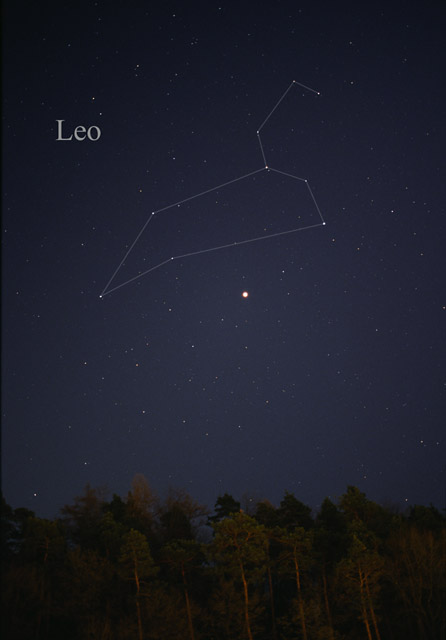
Leo is one of the twelve zodiac constellations, the name "zodiac" sharing its origin with the word "zoo" -- appropriate for the ring of mythical animals found in the sky. Leo is a very easy-to-locate constellation because it has one very bright star (Regulus) and quite a few moderately bright stars in a distinctive pattern that resembles a lion. The image at left shows the general outline of the stars in Leo, with the sickle (or backwards question mark) at the head of the lion, something that is easily identifiable as Leo rises in the east in the winter. For the coming months, it will be appearing higher in the east and traversing nearly overhead throughout the evening.

Because they form a band around the sky that follows the Sun's path, each of the zodiac constellations has frequent visitors as they grace the night sky, from the Moon to the planets. Leo has been the home of Saturn for the last three years, but now Saturn is drifting slowly eastward into Virgo. On the west side of Leo is Mars, currently in retrograde in Gemini, but soon to be speeding toward Leo and a close encounter with the bright star Regulus in June.

Take some time to become acquainted with this celestial Lion, and you'll know how to quickly navigate to Saturn and Mars throughout the spring and into the summer.

Monday, September 14, 2009

Brilliant Venus shining in the morning sky

Venus, the brilliant morning "star", dominates the morning sky. During the next week it will have a close encounter with the waning Moon and then a very close alignment with Regulus, the brightest star in the zodiac constellation Leo. Now that the sunrise is getting later each morning, it's not so unusual to get up when it is dark enough to see brilliant Venus in the eastern sky. The diagrams will help you to find your way in the eastern sky.