Showing posts with label Zodiac. Show all posts

Monday, May 2, 2011

The Last Vestiges of the Winter Sky

The young Moon graces the last vestiges of the winter sky this week, creating a beautiful pattern in the west for several evenings in a row. The big, bold constellations of winter including Orion, Taurus and Canis Major, and the very distinctive asterism the Winter Triangle are sinking lower each evening into the glow of the sunset sky, and on May 4th, 5th and 6th the Moon enters the picture to create a spectacular evening picture.

I have been doing Star Parties and outdoor presentations on astronomy the last few weeks, and the change from week to week has been dramatic. There is a natural change to the sky each evening, as the constellations and bright stars along the celestial equator and zodiac (ecliptic) move approximately 1 degree westward toward the sunset. At the same time, the length of each day is growing, meaning that these great winter constellations are disappearing rapidly into the glare of sunset. But there is nothing to worry about -- they will make their way around the sky to rejoin the view in the early morning, and continue the great ritual of the sky changing slowly from one season to the next.

Thursday, January 20, 2011

KFOG Podcast - January 20, 2011

My monthly conversation with KFOG Morning Show's Irish Greg moved from the new Zodiac signs (such as Ophiuchus) to the Aurora Borealis to the big bold winter constellations such as Orion and bright stars such as Sirius. Click here to listen and get inspired to look up at the sky tonight!

Saturday, May 8, 2010

Planets and Bright Stars along the Ecliptic

This is a great time of year to enjoy the view of bright stars and planets demarcating the ecliptic. I am hosting a lot of star parties these days (last week in Tomales, this week in Fremont, next week in Healdsburg and the week after in San Mateo) and I always love to point out the ecliptic, the band across the sky where the planets and Moon are found in their wanderings across the heavens.

The ecliptic is the plane of the Solar System, the imaginary line across the sky that marks the orbits of the planets and the Moon. In a planetarium this can easily be shown, but under the heavens it is daunting to visualize this. I use a laser pointer to show the path across the sky, and that helps to visualize this, but right now the skies are cooperating to make this a bit easier for those of you without an amateur astronomer and a laser pointer :-)

Face South about 30-45 minutes after sunset and you will be looking toward the ecliptic. It stretches from the point of sunset to your right (West) where bright Venus gives you one reference point, then stretches up and toward the south to Castor and Pollux, the two twin stars of the zodiac constellation Gemini. Just to the upper left of the pair is bright orange Mars, and continuing left you encounter blue-white Regulus, the brightest star in the zodiac constellation Leo. Now the line of the ecliptic moves down toward the East, that is, down and to the left as you face South. Lower left of Leo is the planet Saturn, a bright, milky-white dot of light. And continuing to the lower left of Saturn is the bright star Spica, in the zodiac constellation Virgo.

Enjoy the tour, and if you have a star chart, put it to work so you can use these bright points of light to help you learn a few constellations. Even in the big city, all of these are visible.

The image on this page was copied from Nick Strobel's Astronomy Notes. Go to his site at www.astronomynotes.com for the updated and corrected version.

Tuesday, February 23, 2010

Winter Sky Show: Gemini, Mars and the Moon

Gemini is one of the finest constellations you can see during the winter months, easy to spot because it traverses the highest spot in the sky (the zenith) and features two bright stars, the twins Castor and Pollux. These two stars are well known because they symbolize the heads of the mythical twins. The stars that make up the rest of the bodies of the twins are less bright and require slightly darker conditions than we will have this week, but I provide an image nonetheless so you can see the rest of the stars when conditions permit.

Mars is the bright orange beacon of light that is gracing the night sky, the brightest object high in the sky for the next many weeks. As Mars orbits the Sun, we observe it moving against the backdrop of the Zodiac constellations, changing its position gradually from month to month as it travels eastward from our Earthbound perspective (this is called prograde motion, in contract to retrograde motion – more on that in a future post). It is about to start moving away from the twins of Gemini through Cancer toward Leo the Lion where it will arrive in May.

The Moon sweeps through this busy part of the sky, passing slightly south of Gemini, Mars and later this week the bright star Regulus in the constellation Leo. The bright Moon will drown out the background stars of these otherwise bright constellations, but the prominent stars Castor, Pollux and Regulus, along with Mars, will shine beside the waxing gibbous Moon. Binoculars or a telescope are a good idea if you want to see this close up!

Monday, February 1, 2010

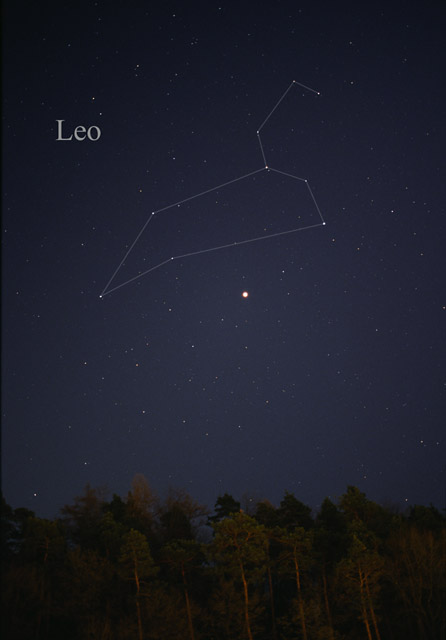
Leo the Lion

Leo is one of the twelve zodiac constellations, the name "zodiac" sharing its origin with the word "zoo" -- appropriate for the ring of mythical animals found in the sky. Leo is a very easy-to-locate constellation because it has one very bright star (Regulus) and quite a few moderately bright stars in a distinctive pattern that resembles a lion. The image at left shows the general outline of the stars in Leo, with the sickle (or backwards question mark) at the head of the lion, something that is easily identifiable as Leo rises in the east in the winter. For the coming months, it will be appearing higher in the east and traversing nearly overhead throughout the evening.

Because they form a band around the sky that follows the Sun's path, each of the zodiac constellations has frequent visitors as they grace the night sky, from the Moon to the planets. Leo has been the home of Saturn for the last three years, but now Saturn is drifting slowly eastward into Virgo. On the west side of Leo is Mars, currently in retrograde in Gemini, but soon to be speeding toward Leo and a close encounter with the bright star Regulus in June.

Take some time to become acquainted with this celestial Lion, and you'll know how to quickly navigate to Saturn and Mars throughout the spring and into the summer.

Monday, January 11, 2010

Review of iPhone astronomy apps: iSolarScape and Planets

My admiration for the iPhone grows as I add more astronomy apps to it. Continuing from my last review of iPhone apps here on the Urban Astronomer blog, I review two more apps that I enjoy using.

iSolarScape: This is an impressive app for $0.99. It provides a broad range of information for the star gazer, from fun facts and figures about the Solar System, to up-to-date information about sunrise, sunset, Moon phase, the location of Jupiter's Galilean Satellites, and more. iSolarScape is the first app I reach for when I want the basics before an evening of stargazing.

The core views of the app are: Sun, Moon, Planets, Asteroids and Zodiac. I use the Sun and Planets selections the most, because they offer me important timing information and wonderful facts and figures about the objects in the Solar System. When I am conducting a star party, iSolarScape has answers to the typical questions (and also the fun and unusual questions) being asked: how far away is a planet, how hot (or cold) is it on the Moon, how many moons does Saturn have, and so on. I marvel at the range of information and ephemeris data I can find throughout the app.

For a great visual tour visit the iSolarScape website.

Planets: This fine app provides a wealth of information and given that the price is free, just load it up and enjoy! A recent upgrade added the "Sky 3D" view, an excellent map of the constellations of the night sky, something that is easy to use and yet quite complete, especially for an Urban Astronomer like me that can only see the brightest stars in constellations most nights. Another view is "Visibility," a planet-by-planet display of when a particular planet is visible in the sky (with back-side data and fun-facts about each object in the Solar System). The "Globe" view is a very cool 3D display of each planet in the Solar System and of course a beautiful Earth map that can be spun around and tilted in any direction allowing you to see the lit side or night side of the Earth.

The publisher of Planets, Dana Peters of QContinuum Software, has a very simple website. For much more vivid illustrations of the Planets app visit the iTunes Store.

I'll have more iPhone asrronomy app reviews in the coming months. Happy viewing!

Sunday, December 20, 2009

Jupiter and Neptune Triple Conjunction: The Finale

For much of 2009 Jupiter and Neptune have been sharing the same space in the sky inside the Zodiac constellation Capricornus. Over the last few months they have moved progressively closer to each other and are now aligned in what is called a "Conjunction." In fact, the year 2009 saw this happen three times in a row, what astronomers call a Triple Conjunction, a rare and beautiful alignment of heavenly bodies.

I had not seen Neptune before this year's Triple Conjunction. A conjunction creates an opportunity to easily locate the less-bright planets Neptune and Uranus. These two are just dim enough to be invisible unless you (a) know exactly where to look, and (b) use optical aid such as a telescope or binoculars. With bright Jupiter as my guide, I was easily able to find Neptune lurking in the neighborhood, a beautiful blue pinpoint of light (see my previous post on the subject, Blue Neptune). The third of the three conjunctions of Jupiter and Neptune is even easier to find this week because the waxing Moon passes just above the duo on the evenings of December 20 and 21. In fact, the Moon makes a splendid guide to the planets each month, having just passed near Mercury a few days ago, and later in the month approaching orange-red Mars and yellow-white Saturn.

For a more detailed view of the paths of Jupiter and Neptune across the night sky check the diagrams on Martin Powell's excellent astronomy website. With these detailed charts, you can get a clear perspective on how these objects slowly make their way from one Zodiac constellation to the next every year. As Jupiter now begins prograde motion away from Capricornus, it will speed across Aquarius and into Pisces during the winter and by spring will be closing in on Uranus, where in 2010 we will have a Triple Conjunction of Jupiter and Uranus. Scroll down this page to see an excellent animation showing the motion of Uranus and Jupiter across the sky in 2010. The heavens never cease to offer up opportunities for discovery. Here's to clear skies!