Showing posts with label Virgo. Show all posts

Sunday, November 20, 2011

Saturn Returns

Saturn has returned to the morning sky, rising higher each day shining in the east before sunrise. It is near the bright blue giant star Spica, in the constellation Virgo, and this week is graced by a visit from the Moon, creating a beautiful grouping on the morning of November 22nd.

Saturn and Spica are an interesting pair to compare. They are a contrast in color, with Spica shining a deep blue, and Saturn with a yellow-white tinge. Spica is 260 light years away, distant compared to many other bright stars in the evening sky, but being a giant star, it emits enough light to be the 15th brightest star in our night sky. Saturn is 80 light minutes away, a giant planet by Solar System standards, but due to its distance it never shines as bright as other Solar System objects such as Venus and Jupiter. But Saturn still captivates all who see it through a telescope because of its impressive ring system, making it a welcome target for any star gazer.

Image courtesy Sky & Telescope Magazine

Monday, August 23, 2010

Perspective of the Solar System

After weeks of foggy skies in San Francisco, the sky has started clearing, yielding spectacular sunsets and sky shows at Ocean Beach. I have been writing about (but not seeing much of) the amazing sight of the planets dancing across the evening sky. With the clear skies, the view was great, showcasing Venus and Mars very close together, with Saturn just to the lower right and the bright Zodiac start Spica (in Virgo) just to the upper left.

This configuration traces a curve in the sky and if you have a clear southern horizon you can "connect the dots" from this cluster of stars and planets to the south where bright Jupiter dominates the sky. Beyond that, the Moon is slicing across the lower southern sky, providing the observer with a nice visual of the Ecliptic, the line of the planets, Moon and Sun. This is a great way to visualize the path of the planets in the Solar System when you look out from our Earth-bound perspective.

Over the coming months, Mars and Saturn and eventually Venus fade, but the giant planet Jupiter will be dominating the Fall skies.

Saturday, May 8, 2010

Planets and Bright Stars along the Ecliptic

This is a great time of year to enjoy the view of bright stars and planets demarcating the ecliptic. I am hosting a lot of star parties these days (last week in Tomales, this week in Fremont, next week in Healdsburg and the week after in San Mateo) and I always love to point out the ecliptic, the band across the sky where the planets and Moon are found in their wanderings across the heavens.

The ecliptic is the plane of the Solar System, the imaginary line across the sky that marks the orbits of the planets and the Moon. In a planetarium this can easily be shown, but under the heavens it is daunting to visualize this. I use a laser pointer to show the path across the sky, and that helps to visualize this, but right now the skies are cooperating to make this a bit easier for those of you without an amateur astronomer and a laser pointer :-)

Face South about 30-45 minutes after sunset and you will be looking toward the ecliptic. It stretches from the point of sunset to your right (West) where bright Venus gives you one reference point, then stretches up and toward the south to Castor and Pollux, the two twin stars of the zodiac constellation Gemini. Just to the upper left of the pair is bright orange Mars, and continuing left you encounter blue-white Regulus, the brightest star in the zodiac constellation Leo. Now the line of the ecliptic moves down toward the East, that is, down and to the left as you face South. Lower left of Leo is the planet Saturn, a bright, milky-white dot of light. And continuing to the lower left of Saturn is the bright star Spica, in the zodiac constellation Virgo.

Enjoy the tour, and if you have a star chart, put it to work so you can use these bright points of light to help you learn a few constellations. Even in the big city, all of these are visible.

The image on this page was copied from Nick Strobel's Astronomy Notes. Go to his site at www.astronomynotes.com for the updated and corrected version.

Monday, February 1, 2010

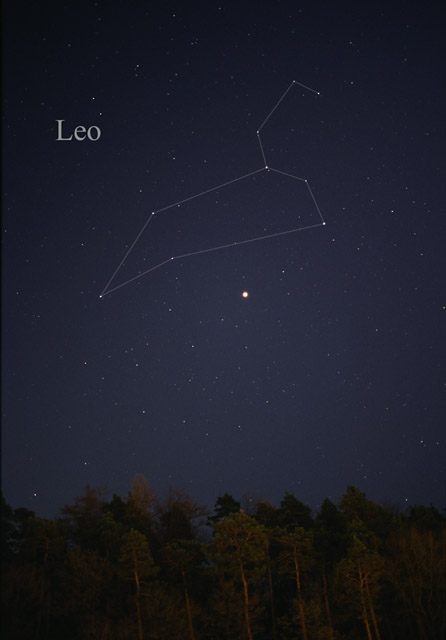
Leo the Lion

Leo is one of the twelve zodiac constellations, the name "zodiac" sharing its origin with the word "zoo" -- appropriate for the ring of mythical animals found in the sky. Leo is a very easy-to-locate constellation because it has one very bright star (Regulus) and quite a few moderately bright stars in a distinctive pattern that resembles a lion. The image at left shows the general outline of the stars in Leo, with the sickle (or backwards question mark) at the head of the lion, something that is easily identifiable as Leo rises in the east in the winter. For the coming months, it will be appearing higher in the east and traversing nearly overhead throughout the evening.

Because they form a band around the sky that follows the Sun's path, each of the zodiac constellations has frequent visitors as they grace the night sky, from the Moon to the planets. Leo has been the home of Saturn for the last three years, but now Saturn is drifting slowly eastward into Virgo. On the west side of Leo is Mars, currently in retrograde in Gemini, but soon to be speeding toward Leo and a close encounter with the bright star Regulus in June.

Take some time to become acquainted with this celestial Lion, and you'll know how to quickly navigate to Saturn and Mars throughout the spring and into the summer.

Monday, November 9, 2009

Moon, Saturn, Corvus, Virgo and Venus

Now that the sky is remaining dark later and later each day, I am enjoying the early morning interplay of Solar System and stellar objects. This week provides a series of lunar alignments with Saturn, the constellation Corvus, the bright star Spica in Virgo, and finally Venus -- if you have an exceptionally clear, low eastern horizon. Sunrise in San Francisco is from 6:45 to 6:50 am this week.