Showing posts with label Cassiopeia. Show all posts

Saturday, February 12, 2011

The Winter Sky Beckons

The Winter Sky beckons me to stop what I am doing and pay attention, for the view of the heavens in this magical season is unlike any other. Here in San Francisco, when it is not raining (as was the case for most of January through today), the air is dry and the atmosphere clear, giving the casual observer sparkling vistas into the heavens. And as this kind of weather happens with regularity in the winter, and the hours of darkness are at their maximum, it is all but impossible to miss the winter sky.

Evenings right now are dominated by the slowly fading planet Jupiter high in the west at sunset, and the colorful bright stars of Orion high in the southern sky, Canis Major and Sirius to the lower left of Orion, and Taurus and Aldeberan to the upper right of Orion. Facing north, the Big Dipper and Cassiopeia trade places every 24 hours, circling Polaris, the North Star. And later in the night to the east are a variety of treasures in Virgo with Saturn in the vicinity. Two weeks ago the morning sky featured the old Moon passing through Scorpios and Sagittarius, creating beautiful alignments that accented the eastern horizon at dawn.

The most important thing to do, if you want to see these amazing sky spectacles, is to keep your eyes open and look up - - nothing more than that is necessary to be captivated by the spell of the sky. No need for a telescope or binoculars. This time of year the stars dazzle in the night, and appear to be asking all of us to take a moment to contemplate their majesty and come to appreciate the universe, awaiting your view each night of the year.

Tuesday, October 12, 2010

An Elusive Comet in Urban Skies: Hunting for Hartley 2

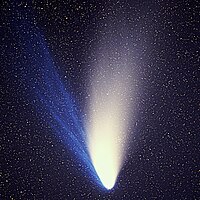
Comets can be bold and brash, streaking across the sky like Hale-Bopp in 1997 (see image on right), a comet that was visible even in light-polluted urban areas. Comets can be more humble but then unexpectedly brighten, as did Comet Holmes in 2007. This year marks the return of periodic Comet Hartley 2, a small but frequent visitor to the inner Solar System that is making a fairly close pass to the Earth (11 million miles) on October 20th. Because of the bright Moon on October 20th, this and last week mark the best chances to see the comet because the Moon is young and not brightening the sky. So I took a look last week and again this week to see if I could spot this elusive comet from a city location (last week in a suburb of Frankfurt, Germany and this week from my home in San Francisco).

I hunted quite a while on both occasions, using this very helpful map from Sky and Telescope Magazine. In fact, S&T has been running updates as viewers report seeing Comet Hartley 2 with binoculars. However, it seems that to see Comet Hartley 2 you need a location with very dark skies. I can attest to this, having twice tried and failed to discern the comet from the surrounding stars.

However, all is not lost. Searching for Hartley 2 requires you to find Cassiopeia, Perseus and Auriga, three very nice constellations that grace the Fall and Winter skies. While searching the path of the comet, you encounter a range of deep space objects near and between Cassiopeia and Perseus, and tonight the view was quite good. So even though city lights may have drowned out the faint comet, I enjoyed my first good look at the Double Cluster in Perseus and other celestial gems in the spiral arm of the Milky Way that is beyond Cassiopeia.

I recommend a good jacket, a comfortable chair or blanket, a few minutes patience, the S&T sky map, and binoculars. No matter whether your hunt for Comet Hartley 2 is a success or not, you will be glad you made the effort.

Wednesday, December 9, 2009

The Northern Sky: Circumpolar Stars and Polaris

I enjoy stargazing for many reasons, one of which is to get a sense of the motion of the sky as viewed from our vantage point here on Earth. As I have traveled around the globe, I've always tried to observe how the sky changes depending on where you view it from. One of the more fundamental things you can observe is the dynamic of the stars and constellations in the northern sky. For those of us who dwell in North America, we see the north star, Polaris, at the same height in the sky as we are located north of the equator. That is, for San Francisco at approximately 38 degrees north latitude, Polaris can be found due north, 38 degrees above the horizon.

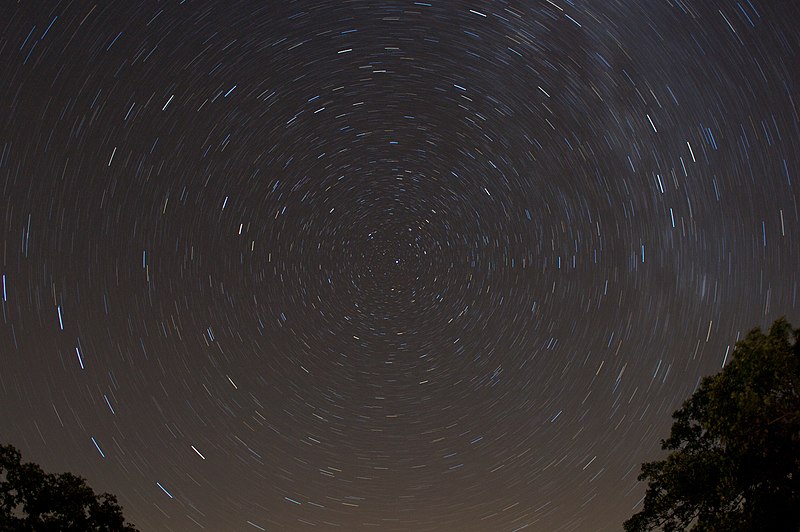
For reasons you can read about in Wikipedia, Polaris does not move in the sky and therefore is never below the horizon. It is always fixed in the north above the horizon at the same arc as you are located north of the equator. However, the stars that surround Polaris also never dip below the horizon, but rather circle around Polaris in a 24-hour spiral that turns counter-clockwise. Long-exposure photographs show this effect very vividly.

Wonderful constellations and asterisms occupy the circumpolar region of the sky, including the Big and Little Dipper, Cassiopeia, Draco and Cepheus.

Monday, August 10, 2009

Perseid Meteor Shower 2009

It's August and that means its time for the annual Perseid Meteor Shower, this year reaching its peak on the evening and through the morning of August 11-12. Meteors are visible just about any night of the year, but throughout the year there are periods of intense activity in the sky ("meteor showers") because the Earth travels through a point in its orbit where there is a higher amount of space dust, rocks and other particles that enter the atmosphere at tens of thousands of miles per hour and burn up, creating bright streaks across the sky.

The Perseid Meteor Shower is going to be harder to see in 2009 because of the bright Moon that rises at 10:40 pm in San Francisco. For the city dweller, however, the shower is not much worse because of the bright Moon, as our city lights obscure many meteors anyhow. So the best you can do is simply enjoy the shower the evening of August 11th from wherever you are in the city. Pick a darkened comfortable spot. Lay back on a blanket and point your feet to toward the north-east and look around the sky. As the evening wears on, the origination point ("radiant") of the meteor shower rises in the north-east. This area is near the constellations Perseus and Cassiopeia as shown in the illustration to the right.

This year there will be a possible jump in the number of meteors as the Earth passes through a denser-than-usual filament of dust from the remnants of comet Swift-Tuttle. That will happen around 1:00 am pacific time on the 12th, so if you are up late you might just see a more intense period of meteor activity. Throughout the entire evening, the Moon will remain the one bright light everyone cannot escape, so when it rises just point your gaze in another direction and keep your eyes on the sky. And stay warm!

If you want to see a good meteor shower this year that won't have moonlight in the way, look ahead to December 14th when the Geminids will peak at an even higher rate than the Perseids. However it will be considerably cooler and the weather is less predictable at that time.