Showing posts with label Sky and Telescope Magazine. Show all posts

Tuesday, October 12, 2010

An Elusive Comet in Urban Skies: Hunting for Hartley 2

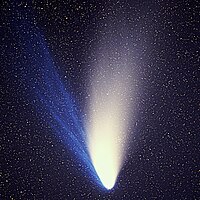
Comets can be bold and brash, streaking across the sky like Hale-Bopp in 1997 (see image on right), a comet that was visible even in light-polluted urban areas. Comets can be more humble but then unexpectedly brighten, as did Comet Holmes in 2007. This year marks the return of periodic Comet Hartley 2, a small but frequent visitor to the inner Solar System that is making a fairly close pass to the Earth (11 million miles) on October 20th. Because of the bright Moon on October 20th, this and last week mark the best chances to see the comet because the Moon is young and not brightening the sky. So I took a look last week and again this week to see if I could spot this elusive comet from a city location (last week in a suburb of Frankfurt, Germany and this week from my home in San Francisco).

I hunted quite a while on both occasions, using this very helpful map from Sky and Telescope Magazine. In fact, S&T has been running updates as viewers report seeing Comet Hartley 2 with binoculars. However, it seems that to see Comet Hartley 2 you need a location with very dark skies. I can attest to this, having twice tried and failed to discern the comet from the surrounding stars.

However, all is not lost. Searching for Hartley 2 requires you to find Cassiopeia, Perseus and Auriga, three very nice constellations that grace the Fall and Winter skies. While searching the path of the comet, you encounter a range of deep space objects near and between Cassiopeia and Perseus, and tonight the view was quite good. So even though city lights may have drowned out the faint comet, I enjoyed my first good look at the Double Cluster in Perseus and other celestial gems in the spiral arm of the Milky Way that is beyond Cassiopeia.

I recommend a good jacket, a comfortable chair or blanket, a few minutes patience, the S&T sky map, and binoculars. No matter whether your hunt for Comet Hartley 2 is a success or not, you will be glad you made the effort.

Wednesday, August 11, 2010

Perseid Meteor Shower 2010

The Perseid Meteor Shower reaches its peak this week and the timing is very good for a fine display of meteors. Every year when the Perseids come around, the biggest concern is the Moon. Its beautiful light is a welcome sight to many, but for amateur astronomers and anyone wishing to see more than a few meteors, moonlight can ruin an otherwise-perfect evening of viewing. This year the Moon is very young during the Perseids and sets not long after sunset, leaving a dark sky for the shower.

The Perseids peak on the nights of Thursday 12th and Friday 13th, with best viewing on Thursday night / Friday morning. You can get detailed information on the Sky and Telescope website or on numerous other web resources.

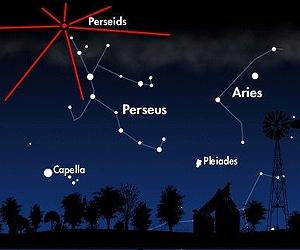
The best way to see the meteor shower is to find a dark location, give your eyes plenty of time to adapt to the darkness, and be prepared to stay up late (or get up early). Meteor showers are almost always best viewed after midnight when the Earth is powering directly into the meteor stream and the rate increases substantially. The Perseids appear to originate in the constellation Perseus which is in the east after midnight, but that does not mean you have to specifically look east to see the meteors. Lying on a blanket facing directly overhead gives you the most expansive view and you can see meteors coming from the east or passing overhead toward the west. Meteors are wonderful, fast, elusive wonders and you simply need to be warmly dressed, in a place where you can see as much of the sky as possible without light distractions, and patience. I wish you clear skies and a great night or two observing.

Sunday, July 11, 2010

A Must See: Four Planets and the Moon

This week the sky features four of the brightest planets in a beautiful lineup in the sunset sky. The illustration on the left, borrowed from Sky & Telescope Magazine, demonstrates how the planets all align themselves in a path across the sky known as the Ecliptic. This line in the sky, actually a gentle curve from west to east across the south part of the sky, is the plane of the Solar System as viewed from our observing platform on Earth. We see fast-moving Mercury close to the Sun, then Venus, Mars and Saturn, a most impressive line-up.

To set this into perspective, the young Moon emerges from the glare of the Sun on Tuesday 13th, moving somewhat parallel to the Ecliptic but each day a bit farther south of the Ecliptic. This is because the orbit of the Moon around the Earth is slightly inclined to the rest of the bodies in the Solar System. And as we just had a Total Solar Eclipse on Sunday, the Moon is following a path away from the Ecliptic into what is called the "descending node" south of the Ecliptic.

I will be talking about this at the California Academy of Sciences at their Nightlife event this Thursday in Golden Gate Park. If you are in or near San Francisco, please join me on the roof for Star Tours!

Saturday, December 12, 2009

Geminid Meteor Shower 2009

One of the finest meteor showers of the year is the Geminids, so named because the meteors appear to emanate from the zodiac constellation Gemini. The shower peaks this year on Sunday evening December 13th and for us on the west coast of the United States, we will be well placed for the peak of the shower at 9:00 pm. Given that there won’t be any moonlight for this meteor shower, conditions are ideal for a good shower that can produce up to 120 meteors per hour in very dark conditions. For those of us who live in urban areas such as San Francisco, we will see considerably fewer meteors. Nonetheless, if you can get yourself away from streetlights, houselights and allow some time to adapt to the dark, you will see some Geminids.

Meteor showers that occur at the same time every year are usually caused by some kind of debris trail that the Earth intersects, showering the upper atmosphere with fine particles in an unusually intense period of time. Based on the way in which the Earth intersects the tiny bits of rock and dust, the meteors will all appear to originate in a single point in the sky, a point known as the "radiant." The Geminid meteor shower appears to originate in the constellation Gemini and as this constellation rises shortly after sunset, this particular meteor shower appears strong all night long, as Gemini treks across the sky from the east nearly directly overhead and then dropping into the west.

NASA has a great website talking about the origins of the Geminids, and Sky & Telescope Magazine has a very helpful article (written by Tony Flanders, an astronomer I've come to know personally) that is full of good tips for seeing the Geminids.

The weather outlook is always a challenge for December, and if the skies are clear they are most assuredly accompanied by a cold evening, so dress extra-warmly for the Geminids and enjoy.

Monday, December 7, 2009

Astronomy Gifts for the Holidays / Telescope Shopping

If you are considering a gift for someone who enjoys astronomy (or want to share something with a young person who might like to discover astronomy), I present to you my astronomy gift guide for the holidays.

A. Astronomy Gifts.

At my local astronomy shop here in San Francisco, Scope City, I asked manager Sam and salesperson Steve what they would recommend for the holidays. Telescopes are plentiful and that warrants a separate section of this blog post - see below. But aside from telescopes, there are binoculars of all types, excellent books, tools such as Star Finders and Planispheres, and new this year, the Sky Scout, a hot selling item from Celestron that has the astronomy hobbyist world abuzz. Point the Sky Scout at an object in the sky and it tells you what the object is and provides additional details. For another approach, you can open a door for astronomy for someone with a gift subscription to Astronomy Magazine or Sky & Telescope Magazine.


B: Telescopes - Top 5 Things to Consider When Buying a Telescope

A telescope is a powerful scientific instrument which, when well cared for, can provide years of viewing pleasure. Top brands include Meade, Orion and Celestron. However, there is a very wide range of options, quality and performance to choose from so before you buy a telescope learn a few things about them. Telescopes.com offers some useful background information, as does Astronomics.com with its informative pages. The Bad Astronomy blog has a helpful article, and this post provides a lot of detail for the telescope shopper. If you summarize all of the articles and if I draw from my own experience, I would recommend five things to think about when purchasing a telescope.

1. Consider Binoculars. They are easy to use, can be used at daytime as well as nighttime, cost less than a telescope, and are a good first test of one's interest in the night sky.

2. Buy quality. Avoid the cheap telescopes at the department stores. They not only have generally poor quality optics, but end up being a turn-off for those who purchase them. It's worth the extra money to get something you will enjoy.

3. Start simple. As much as the high-tech telescopes look like fun, they are still complex instruments that will need some degree of care-and-feeding when you use them. The most basic scopes, simple refractors on a lightweight tripod, take little time to set up and are the most simple to use. Also, a simple telescope is not as bulky and heavy to carry around. For kids, try out the Celestron FirstScope (see below).

4. Be comfortable. You really need to feel at ease with a telescope, so in the best case go to your local astronomy shop and try out a few. Scope City will let you take their binoculars and telescopes out in front of the store and do the "Safeway Test" to see how well you can resolve items in the aisles of Safeway grocery store next door.

5. Learn to use your telescope at your local astronomy club. Amateur astronomers like to help others to learn about astronomy. The San Francisco Amateur Astronomers and San Francisco Sidewalk Astronomers hold Telescope Clinics at their monthly star parties. These are excellent venues to bring your scope and learn to use it with astronomy enthusiasts. Check the Night Sky Network for a club near you.

C: For Young People.

Kids can benefit from astronomy gifts that are easy to use and make it simple to immediately start enjoying. I found numerous websites that showcase books for kids. Skymaps.com has a very well organized list of books for different age ranges, all the way from age 4 to young adult and educator. The Top 10 Astronomy Books for Kids on about.com offers some good choices. On the telescope front in 2009, Celestron premiered the FirstScope, an extremely simple telescope for kids that, from the reviews I've read, is surprisingly good quality yet very low price (about $50 at most outlets). It is an 'official product' of the International Year of Astronomy (IYA) celebration. But in the end I was most enamored with this simple recommendation from the Suite101.com blog:

"What children really need, more than 'stuff,' is for someone to take the time to stand outside with them on a starry night and point out planets and constellations. Teach them the sky. You can give coupons good for '1 Hour of Observing with Mom' or something similar."


Happy Holidays. Stay warm and enjoy the long dark nights.
Wednesday, July 22, 2009

Total Solar Eclipse in Asia

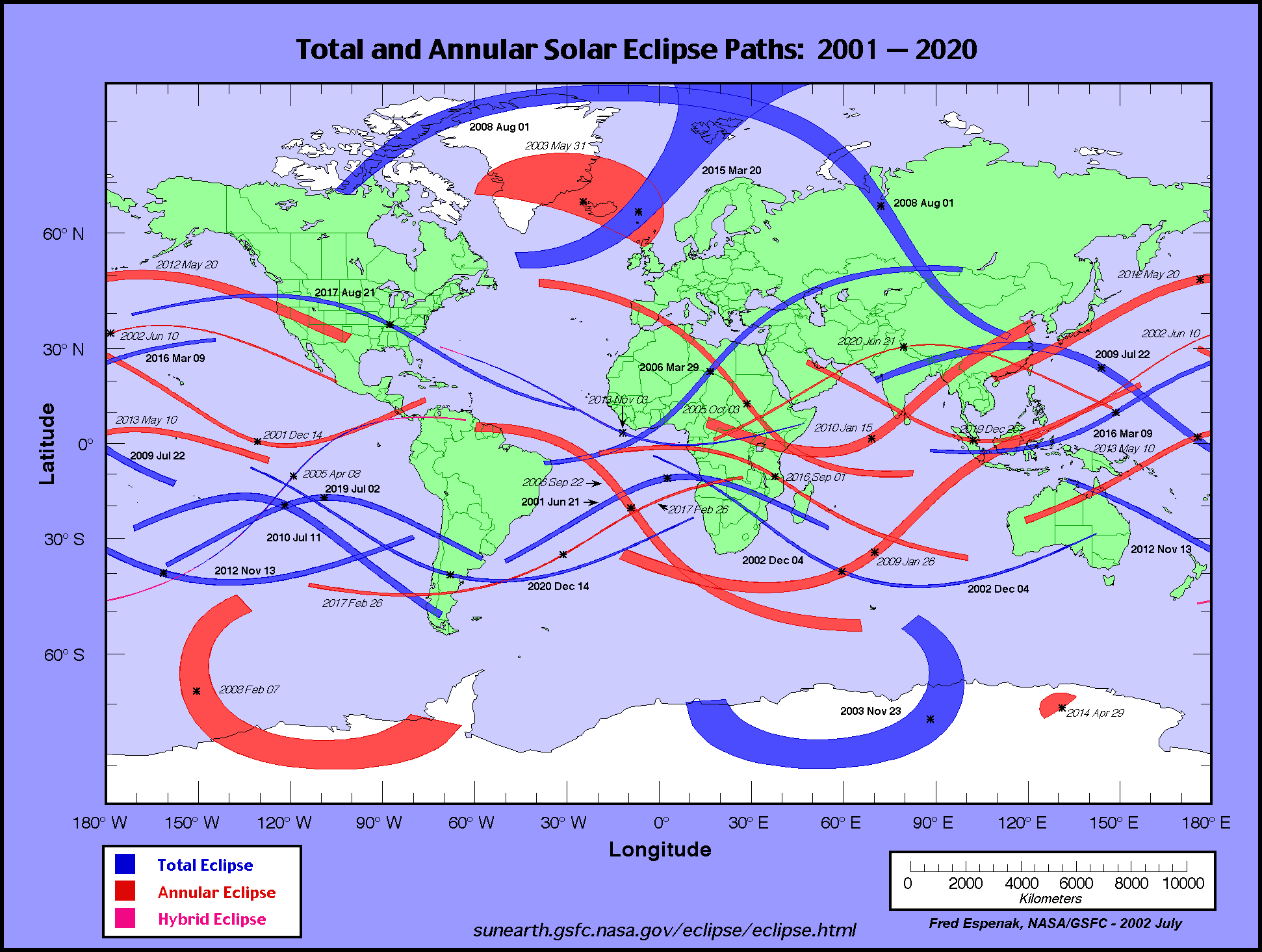
Today a large part of the eastern hemisphere experienced a solar eclipse, and along a narrow band of Earth viewers were well positioned to experience a Total Solar Eclipse, a rare and beautiful phenomenon. Unfortunately for most, the summer weather was miserable and the skies were cloudy - something that eclipse viewers (and eclipse chasers like me) don't want. Still, there was some limited visibility from a few observing sites. The tour group organized by Sky & Telescope Magazine saw a "murky" total solar eclipse. Better than none, I suppose.

For those of you wishing to see one closer to home, you'll have to wait until 2017 for a Total Solar Eclipse in the USA.