Showing posts with label Solar System. Show all posts

Sunday, November 20, 2011

Saturn Returns

Saturn has returned to the morning sky, rising higher each day shining in the east before sunrise. It is near the bright blue giant star Spica, in the constellation Virgo, and this week is graced by a visit from the Moon, creating a beautiful grouping on the morning of November 22nd.

Saturn and Spica are an interesting pair to compare. They are a contrast in color, with Spica shining a deep blue, and Saturn with a yellow-white tinge. Spica is 260 light years away, distant compared to many other bright stars in the evening sky, but being a giant star, it emits enough light to be the 15th brightest star in our night sky. Saturn is 80 light minutes away, a giant planet by Solar System standards, but due to its distance it never shines as bright as other Solar System objects such as Venus and Jupiter. But Saturn still captivates all who see it through a telescope because of its impressive ring system, making it a welcome target for any star gazer.

Image courtesy Sky & Telescope Magazine

Wednesday, October 12, 2011

Brilliant Moon and Jupiter

The Full Moon dominates the night sky this week, lighting the Autumn landscape and making its presence known as the soft grey glow of moonlight washes out all but the brightest stars in the sky. But even as the stars take a back seat in the night sky, the giant planet Jupiter shines steadily next to the Moon, undiminished by the intense glow of our nearest celestial neighbor.

Jupiter is nearing "opposition" in which it is at its closest approach to Earth for 2011. That means that it is also at its brightest, outshining all other celestial bodies in the night sky right now, except the Moon. For the next few nights as the Hunter's Moon passes near Jupiter, your attention will be drawn to the dazzling brightness of the largest planet in the Solar System. And once the Moon has moved into Last Quarter phase next week, Jupiter will remain steadfast in the evening sky, waiting for you to find it in binoculars or a small telescope. Take a moment and look up close if you have not seen Jupiter up-close. It's a worthy (and easy) target.

Image courtesy of Sky & Telescope Magazine.

Saturday, July 16, 2011

One Year on Neptune

We passed a landmark moment this month, the one-year anniversary of the discovery of the Blue Planet, Neptune -- one Neptunian-year, that is, which is 165 of our Earth-years. This gem of a planet is something that an urban astronomer has to work a bit harder to see, but once spotted it is a lovely blue point of light in the sky, a fine payoff for those with the persistence to track it down against the backdrop of stars in the heavens.

During its long trek around the Solar System, Neptune has periodic close encounters with other planets, as it did during the "Triple Conjunction of 2009" with Jupiter. However, this year it stands alone in the constellation Aquarius, more challenging to find because we don't get Jupiter as a beacon leading us to find the elusive blue planet. However, using this star chart, a pair of binoculars, a dark backyard location, and some patience, I am sure you can find it. I will be looking from time to time over the coming months as Neptune moves from the morning sky into the evening sky, scanning for its dim blue glow in the vastness of the night sky.

Tuesday, October 12, 2010

An Elusive Comet in Urban Skies: Hunting for Hartley 2

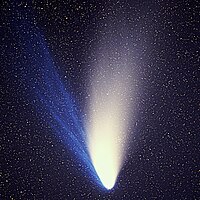
Comets can be bold and brash, streaking across the sky like Hale-Bopp in 1997 (see image on right), a comet that was visible even in light-polluted urban areas. Comets can be more humble but then unexpectedly brighten, as did Comet Holmes in 2007. This year marks the return of periodic Comet Hartley 2, a small but frequent visitor to the inner Solar System that is making a fairly close pass to the Earth (11 million miles) on October 20th. Because of the bright Moon on October 20th, this and last week mark the best chances to see the comet because the Moon is young and not brightening the sky. So I took a look last week and again this week to see if I could spot this elusive comet from a city location (last week in a suburb of Frankfurt, Germany and this week from my home in San Francisco).

I hunted quite a while on both occasions, using this very helpful map from Sky and Telescope Magazine. In fact, S&T has been running updates as viewers report seeing Comet Hartley 2 with binoculars. However, it seems that to see Comet Hartley 2 you need a location with very dark skies. I can attest to this, having twice tried and failed to discern the comet from the surrounding stars.

However, all is not lost. Searching for Hartley 2 requires you to find Cassiopeia, Perseus and Auriga, three very nice constellations that grace the Fall and Winter skies. While searching the path of the comet, you encounter a range of deep space objects near and between Cassiopeia and Perseus, and tonight the view was quite good. So even though city lights may have drowned out the faint comet, I enjoyed my first good look at the Double Cluster in Perseus and other celestial gems in the spiral arm of the Milky Way that is beyond Cassiopeia.

I recommend a good jacket, a comfortable chair or blanket, a few minutes patience, the S&T sky map, and binoculars. No matter whether your hunt for Comet Hartley 2 is a success or not, you will be glad you made the effort.

Monday, August 23, 2010

Perspective of the Solar System

After weeks of foggy skies in San Francisco, the sky has started clearing, yielding spectacular sunsets and sky shows at Ocean Beach. I have been writing about (but not seeing much of) the amazing sight of the planets dancing across the evening sky. With the clear skies, the view was great, showcasing Venus and Mars very close together, with Saturn just to the lower right and the bright Zodiac start Spica (in Virgo) just to the upper left.

This configuration traces a curve in the sky and if you have a clear southern horizon you can "connect the dots" from this cluster of stars and planets to the south where bright Jupiter dominates the sky. Beyond that, the Moon is slicing across the lower southern sky, providing the observer with a nice visual of the Ecliptic, the line of the planets, Moon and Sun. This is a great way to visualize the path of the planets in the Solar System when you look out from our Earth-bound perspective.

Over the coming months, Mars and Saturn and eventually Venus fade, but the giant planet Jupiter will be dominating the Fall skies.

Friday, July 16, 2010

KFOG Podcast - July 16, 2010

I was in San Francisco this morning recording another podcast for the KFOG Morning Show Podcast Series. Morning Show Producer Irish Greg and I had a very spirited and lively conversation about planets, the Solar System, Star Parties, Iridium Flares, Dark Energy and Dark Matter. In a fast-paced 9-minute conversation we discuss everything from the phase of the Moon to the origin of the Universe. Get inspired to see the sky tonight: Click here to listen.

Monday, October 12, 2009

Planetary Motion

The morning sky continues to be a busy place, showcasing just how much action is taking place in the Solar System. Saturn, a relatively slow moving outer planet is gradually rising up in the east, emerging each morning a minute or two earlier so that it will soon be a true morning star. As it graces the dawn sky just ahead of the sunrise, it is encountering the two fast-moving inner planets, Venus and Mercury. This week they have close encounters and beautiful alignments that will be a sight to see. The illustrations provide a sense of how far Venus and Mercury move over the course of just a few days. The passing of the waning Moon on the mornings of the 15th and 16th add a nice touch to an already impressive lineup of Solar System objects.